
Moderate
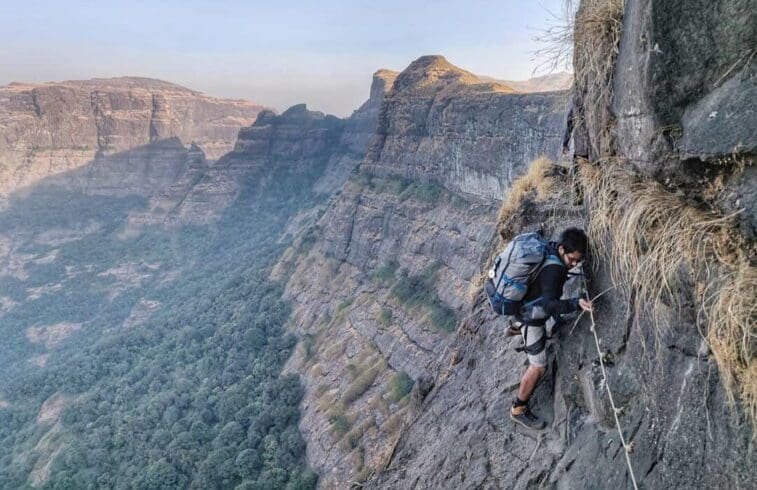
AMK – Alang Madan Kulang Trek
AMK - Alang Madan Kulang Trek Nestled in the heart of the Sahyadri Range in Maharashtra, the Alang…
Kalsubai Peak Trek runs 2 days in Maharashtra, graded Easy, from Rs 1,800 per person.
The trek begins at Bari village, in the Bhandardara region roughly three hours from Mumbai and Pune, making it one of the most accessible genuine trekking destinations for weekend visitors from either city. The summit itself rewards the climb with a panorama that, on a clear day, extends across much of the Sahyadri range — neighbouring peaks and forts including Alang, Madan, and Kulang visible in one direction, and the vast Bhandardara reservoir catching the light in another. What sets Kalsubai apart from the many similar forts and peaks scattered across the Sahyadris is its final approach. During monsoon season, cloud frequently rolls across the summit in waves, alternately obscuring and revealing the surrounding hills in a way that has made sunrise and sunset here particularly popular among photographers. The trail climbs through typical Sahyadri terrain — laterite rock, sparse deciduous forest, and, through the monsoon months of June to September, a landscape utterly transformed by rain, with temporary waterfalls cascading down the plateau edges and the entire hillside carpeted in fresh green grass and wildflowers.
Kalsubai is the highest peak in Maharashtra at about 1,646 m (5,400 ft). Bari village is the base, sitting at around 730 m, and the ascent from it is roughly 800 m. The walking route is about 4 km one way and takes three and a half to four hours to climb. The trail is a mix of rock steps, ladders and open ground, with iron ladders fixed on the steeper sections. A small Kalsubai Devi temple stands at the summit. No formal forest permit is required, but reporting to the Bari village sarpanch before starting is the local convention. Bari is about 152 km from Mumbai and 180 km from Pune, reached via Igatpuri and Ghoti. The peak sits in the Bhandardara region, and the view from the top takes in the surrounding Sahyadri ridges and the Bhandardara backwaters. Kalsubai sits in the Kalsubai range of the Sahyadris, which holds several of the highest peaks in Maharashtra. The range also contains Alang, Madan and Kulang, the technical traverse that is treated as the hardest trek in the state. Ratangad and Harishchandragad are the other well-known forts in the same range, and both are usually done as separate trips. The Bhandardara backwaters sit below the peak and are visible from the upper ladders. The ladders on the upper section are fixed to the rock and are the reason the climb is graded moderate rather than easy. Bari village has homestays, and most groups arrive the night before to start at first light.
At this height the limit on the Kalsubai Peak Trek is fitness and heat rather than oxygen, which makes the descent the part people underestimate.
The Kalsubai Peak Trek assembles at Mumbai, and the day numbering runs from that point. Reporting times and the exact pickup point for the Kalsubai Peak Trek are confirmed on booking.
The Kalsubai Peak Trek is a realistic first outing, since its 2 days are short enough that fitness is not the barrier. Families with older children and anyone returning to walking after a break fit the Kalsubai Peak Trek comfortably. Solo travellers move inside a led group on the Kalsubai Peak Trek, so the pace is collective rather than personal.
Heat and sun are bigger risks than cold on the Kalsubai Peak Trek, so a cap, sunscreen and more water than feels necessary matter most. Footwear decides the day on the Kalsubai Peak Trek: loose stone and wet ground cause most slips, and a worn sole is the usual reason people struggle on the descent. Carry two litres of water each on the Kalsubai Peak Trek, a small first-aid kit, a head torch for pre-dawn walking, and food already tested on a training walk.
The main risks on the Kalsubai Peak Trek at this height are slips on wet sections and dehydration on exposed stretches, both prevented by steady pacing. A certified leader carries first aid and safety kit on the Kalsubai Peak Trek and reviews the forecast each morning, so the plan stays provisional until conditions are known. Travel insurance that covers trekking at this altitude is worth the small extra cost and is not part of the Kalsubai Peak Trek price.
The Rs 1,800 price of the Kalsubai Peak Trek covers accommodation on the itinerary, the listed meals, a certified leader with support crew, applicable permits and entry fees, and the safety equipment carried. Excluded from the Kalsubai Peak Trek are travel to the assembly point unless the itinerary says otherwise, personal kit and clothing, insurance, and anything the inclusions list does not name.
Browsing by region or activity is often faster than reading individual pages, so start with Maharashtra. The closest alternatives to the Kalsubai Peak Trek are AMK – Alang Madan Kulang Trek, which suit anyone comparing dates or a slightly different grade.
At 1,646 metres, Kalsubai is the highest peak in Maharashtra, and despite its modest altitude by Himalayan standards, it has become one of the most popular short treks in western India — largely thanks to a monsoon transformation that turns the entire Sahyadri range into a lush, waterfall-streaked green, and a summit ascent that involves genuinely climbing a series of iron ladders bolted directly into the rock face, giving the trek a small but memorable technical flourish that few other easy-grade treks in the country offer.
The trek begins at Bari village, in the Bhandardara region roughly three hours from Mumbai and Pune, making it one of the most accessible genuine trekking destinations for weekend visitors from either city. The trail climbs through typical Sahyadri terrain — laterite rock, sparse deciduous forest, and, through the monsoon months of June to September, a landscape utterly transformed by rain, with temporary waterfalls cascading down the plateau edges and the entire hillside carpeted in fresh green grass and wildflowers.
What sets Kalsubai apart from the many similar forts and peaks scattered across the Sahyadris is its final approach. As the trail nears the summit, the gradient steepens into a series of exposed rock faces, and rather than a scramble, trekkers ascend via four sets of sturdy iron ladders fixed into the cliff, complete with handrails — a deliberate safety measure installed given the peak’s popularity, but one that still delivers a genuine, if brief, sense of exposure and achievement uncommon on treks graded this easy.
At the summit stands a small temple dedicated to the goddess Kalsubai, after whom the peak is named, and local legend holds that a woman named Kalsubai once lived and died on this mountain, her memory subsequently honoured by villagers who built the shrine in her name — a story reflected in the peak’s continued status as a site of local pilgrimage, with villagers from surrounding areas climbing to the temple during particular festival periods each year.
The summit itself rewards the climb with a panorama that, on a clear day, extends across much of the Sahyadri range — neighbouring peaks and forts including Alang, Madan, and Kulang visible in one direction, and the vast Bhandardara reservoir catching the light in another. During monsoon season, cloud frequently rolls across the summit in waves, alternately obscuring and revealing the surrounding hills in a way that has made sunrise and sunset here particularly popular among photographers.
Because the trek can be completed comfortably within a single day, though most groups extend it to two days with a night of camping near the base or on a nearby plateau, Kalsubai has become the default recommendation for Mumbai and Pune trekking clubs organising short, accessible outings — technical enough via the ladder sections to feel like a genuine achievement, yet gentle enough overall for first-time trekkers, families with older children, and anyone looking for a quick, rewarding escape into the Sahyadris without a long journey or serious physical commitment.
The Kalsubai Peak Trek runs for 2 days. The day-by-day itinerary above lists each stage, walking distance and overnight stay.
The Kalsubai Peak Trek is rated Easy by WDRLUST. It suits first-time trekkers with reasonable fitness. Training with 45 to 60 minutes of cardio three times a week for six weeks before departure is enough for most people.
The Kalsubai Peak Trek starts at Rs 1,800 per person. The price covers the inclusions listed on this page. Transport to the starting point, personal gear and anything not listed under inclusions are extra.
The route reaches approximately 1,646 m. Walk slowly, drink water and report any headache or nausea to your trek leader.
Group size is capped at Max 25 trekkers per departure, with a certified trek leader. Smaller groups mean faster head counts and more attention on the trail.
The Kalsubai Peak Trek starts from the base location described in the itinerary above. WDRLUST shares exact meeting points, reporting times and transport options on booking confirmation. The nearest major access region is Maharashtra.
Kalsubai is the highest point in Maharashtra, in the Sahyadris near Bari village, and it is famous for a set of iron ladders bolted to the rock near the top. From Bengaluru this is a flight-and-drive trek rather than a road trip, which changes the cost calculation entirely.
The trek fee is Rs 1,800 per person, which is the smallest part of the budget here:
Plan on Rs 11,000 to Rs 17,000 all-in from Bengaluru. The trek fee is barely a tenth of it, which is the honest arithmetic for any Sahyadri trek done from Karnataka.
Rated Easy, which reflects the distance: about 6 km up with roughly 800 m of gain. The gradient is steady and the trail is well worn, so the walking itself is not the problem.
The ladders are the part the grade does not capture. Three sets of iron ladders are fixed to exposed rock near the summit, and while they are sturdy and regularly used by thousands of trekkers, they demand a head for heights and both hands free. If you are uneasy with exposure, this is the section to think about before booking, not on the day.
Wet ladders and wet rock are the reason monsoon ascents are treated seriously here. Metal rungs get slick, and the rock around them offers no grip. Many groups turn back at the ladders in heavy rain, which is the correct call rather than a failure.
Above the ladders the summit is exposed with a small temple structure as the only shelter. Lightning during pre-monsoon or monsoon storms is a real risk on that ridge.
Fly to Mumbai or Pune on Friday night, drive to Igatpuri or Bari and sleep, climb at dawn on Saturday, and fly back Sunday. That is the only shape that works in a weekend. Cheaper alternatives exist through overnight trains to Nashik or Igatpuri, but they add a full day each way and turn a two-day trip into four.
Explore related pages: All treks in Maharashtra · Browse all destinations · All activities.
Drive to Bari village, trek to the base of the final ascent, overnight camping.
Pre-dawn climb via the iron ladder sections to Kalsubai summit (1,646m), Maharashtra's highest point, descend and drive back.
AMK - Alang Madan Kulang Trek Nestled in the heart of the Sahyadri Range in Maharashtra, the Alang…
Overview of the Harishchandragad Trek The Harishchandragad Trek is a 2-day, 1-night moderate trek in Maharashtra priced from…
Konkan coast road trip, 6 days from Pune: Ganpatipule, Tarkarli, Sindhudurg and Vijaydurg forts, Malvani food. Easy, from…