
Moderate
Spiti Valley Trip From Delhi
Spiti Valley Spiti Valley The Land of Raw Beauty and High-Altitude Adventures Introduction Nestled in the cold desert…
Annapurna Base Camp holds a slightly different appeal than its more famous Everest counterpart — rather than a single distant summit view, this trek delivers a genuine amphitheatre, walking directly into a natural bowl entirely encircled by peaks above 7,000 metres, with Annapurna I, Machapuchare, Hiunchuli, and Gangapurna rising almost vertically on every side. It’s widely considered one of the most immersive high-altitude experiences in Nepal precisely because the mountains don’t just frame the view — by the final day, they surround it completely.
The trek begins with a drive from Pokhara to Nayapul, and the early stages pass through a landscape strikingly different from the Khumbu’s Sherpa villages — this is Gurung and Magar country, with stone-paved trails linking villages like Ghandruk and Chhomrong, their terraced rice paddies giving way gradually to rhododendron forest as the trail climbs. Ghandruk in particular is one of the largest and best-preserved traditional Gurung settlements in the region, its slate-roofed houses stacked along a hillside with Annapurna South visible directly above.
Beyond Chhomrong, the trail narrows into the Modi Khola gorge, and the character of the trek shifts noticeably — dense forest gives way to bamboo groves and increasingly dramatic cliff-side trail sections, with waterfalls cascading down the gorge walls on both sides. This stretch, through Sinuwa and Bamboo, is often cited by repeat visitors as the most atmospheric part of the entire trek, the trail hemmed in tightly by rock and vegetation before opening out again near Deurali.
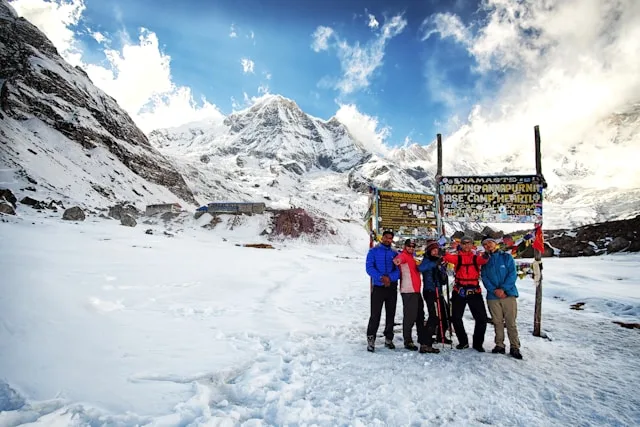
Machapuchare Base Camp, the second-to-last stop, sits at the point where the gorge finally opens into the base of the Annapurna Sanctuary itself, with Machapuchare’s distinctive fishtail-shaped summit rising directly overhead — a peak considered sacred in local tradition and, as a result, never officially climbed, out of respect for that belief. From here, the final push to Annapurna Base Camp itself, at 4,130 metres, delivers the trek’s full reward: a complete circle of Himalayan giants, best experienced at sunrise when the entire amphitheatre catches first light simultaneously.
Jhinu Danda, a short detour on the return journey, offers a welcome and slightly unusual contrast — natural hot springs beside the Modi Khola river, where trekkers commonly spend an afternoon soaking tired legs after the sustained climbing and descending that defines much of the trek’s middle section. This kind of built-in recovery stop is one of several small touches that make the Annapurna region’s trail infrastructure particularly well suited to trekkers, with teahouses at every stage offering hot meals and warm rooms rather than tented camping.
Because the trek sustains altitude gain and loss over many consecutive days rather than a single dramatic summit push, physical conditioning matters as much as altitude acclimatisation, and a realistic, patient pace is generally more important here than raw fitness. For trekkers seeking genuine high-Himalayan immersion with well-established teahouse comfort along the way, Annapurna Base Camp remains one of Nepal’s most rewarding and complete trekking experiences.
Fly or drive from Kathmandu to Pokhara. Rest and trek briefing.
Drive to Nayapul, trek to Tikhedhunga village.
Climb through rhododendron forest to Ghorepani, with views of Dhaulagiri.
Sunrise hike to Poon Hill for panoramic views, trek onward to Tadapani.
Descend and climb through forest to the Gurung village of Chhomrong.
Descend into the Modi Khola gorge, trek through bamboo forest to Bamboo campsite.
Continue up the narrowing gorge to Himalaya campsite.
Trek to Machapuchare Base Camp (3,700m), first full views into the Annapurna Sanctuary.
Reach Annapurna Base Camp (4,130m) for sunrise views of the full amphitheatre, descend to Bamboo.
Descend to Jhinu Danda, relax at the natural hot springs.
Final descent to Nayapul and drive back to Pokhara.
Fly or drive from Pokhara to Kathmandu for onward journey.
Spiti Valley Spiti Valley The Land of Raw Beauty and High-Altitude Adventures Introduction Nestled in the cold desert…
Ladakh's most iconic village-to-village trek crosses two high passes and follows the Markha river past whitewashed monasteries, all…
Kedarkantha trek Do you want to experience the thrill of summiting a mountain in the winter? The Kedarkantha…