
Moderate
Dzukou Valley Trek
A remote highland valley on the Nagaland-Manipur border, famed for a short-lived carpet of endemic Dzukou lilies that…
Dudhsagar Trek runs 1 day in Karnataka, graded Moderate, from Rs 2,800 per person.
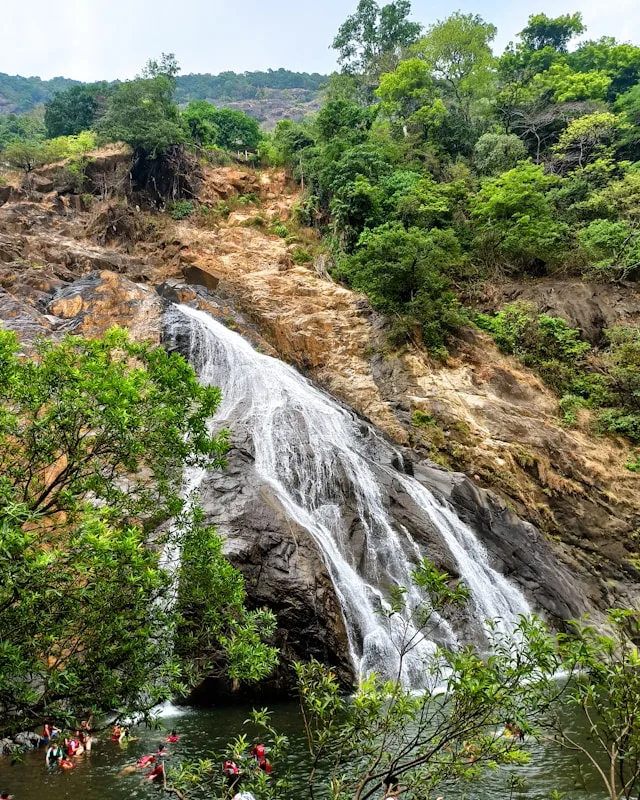
Dudhsagar Falls — literally “Sea of Milk,” a name earned from the churning white spray the falls generate as they drop roughly 320 metres down a sheer rock face — sits on the border between Goa and Karnataka, within the Bhagwan Mahavir Wildlife Sanctuary, and ranks among the tallest waterfalls in India. The trek typically begins at Kulem (Colem) station, within Goa, following the South Western Railway line that connects the coastal state to the Deccan plateau — a route built during the colonial era specifically to move goods between Goa’s port and the interior, now shared, with appropriate caution and local guide supervision, by trekkers making their way toward the falls. During peak monsoon season, from June through September, the falls run at their most powerful and voluminous, though swimming in the plunge pool beneath is often restricted during this period given the genuinely dangerous water flow; the post-monsoon months of October and November typically offer both strong flow and safer swimming conditions. This blend of managed adventure and genuine natural spectacle has made Dudhsagar one of the most popular short treks accessible from Goa’s beach-focused tourist circuit. Approaching the falls themselves, the roar becomes audible well before the cascade comes into view, the sound intensifying with each bend in the trail until the full scale of the falls is finally revealed — a wide curtain of water dropping in stages down a granite rock face, framed by dense forest on both sides. Unlike most Indian waterfall treks, though, the approach here follows an active broad-gauge railway line for a significant stretch, giving the trek an unusual industrial-meets-wilderness character found nowhere else on this list.
Dudhsagar Falls drops about 310 m in four tiers on the Mandovi river. The base is reached by jeep from Kulem, because private vehicles are not allowed on the sanctuary track. The walk from the jeep drop to the falls is short and flat, following the railway line. The railway line to Castle Rock passes close to the falls, and the Dudhsagar station is a stop on that route. The falls are at their heaviest in the monsoon, when the sanctuary sometimes closes the track for safety.
At this height the limit on the Dudhsagar Trek is fitness and heat rather than oxygen, which makes the descent the part people underestimate.
The Dudhsagar Trek suits people who already walk but have not necessarily trekked, since its 1 day ask for stamina rather than skill. A fit beginner who prepares gets through the Dudhsagar Trek; someone treating it as a stroll does not. Solo travellers move inside a led group on the Dudhsagar Trek, so the pace is collective rather than personal.
Heat and sun are bigger risks than cold on the Dudhsagar Trek, so a cap, sunscreen and more water than feels necessary matter most. Footwear decides the day on the Dudhsagar Trek: loose stone and wet ground cause most slips, and a worn sole is the usual reason people struggle on the descent. Carry two litres of water each on the Dudhsagar Trek, a small first-aid kit, a head torch for pre-dawn walking, and food already tested on a training walk.
The main risks on the Dudhsagar Trek at this height are slips on wet sections and dehydration on exposed stretches, both prevented by steady pacing. A certified leader carries first aid and safety kit on the Dudhsagar Trek and reviews the forecast each morning, so the plan stays provisional until conditions are known. Travel insurance that covers trekking at this altitude is worth the small extra cost and is not part of the Dudhsagar Trek price.
The Rs 2,800 price of the Dudhsagar Trek covers accommodation on the itinerary, the listed meals, a certified leader with support crew, applicable permits and entry fees, and the safety equipment carried. Excluded from the Dudhsagar Trek are travel to the assembly point unless the itinerary says otherwise, personal kit and clothing, insurance, and anything the inclusions list does not name.
Wildlife sightings, while not guaranteed given the dense cover, can include Malabar giant squirrel, various hornbill species, and, for the fortunate, glimpses of the sanctuary’s leopard population via tracks rather than direct sighting. Walking beside and occasionally across the tracks, through several tunnels bored directly through the hillside, gives the early stages of this trek a genuinely distinctive rhythm compared to typical forest trails. The railway line itself carries an additional layer of local folklore and, more concretely, real safety considerations — active trains do use this route, and reputable guides maintain strict protocols around timing and awareness during the trail’s railway sections, a genuinely unusual but well-managed aspect of an otherwise typical monsoon jungle trek.
Browsing by region or activity is often faster than reading individual pages, so start with Goa. The closest alternatives to the Dudhsagar Trek are Skandagiri Trek, Makalidurga trek and Savandurga Trek, which suit anyone comparing dates or a slightly different grade.
Dudhsagar Falls — literally “Sea of Milk,” a name earned from the churning white spray the falls generate as they drop roughly 320 metres down a sheer rock face — sits on the border between Goa and Karnataka, within the Bhagwan Mahavir Wildlife Sanctuary, and ranks among the tallest waterfalls in India. Unlike most Indian waterfall treks, though, the approach here follows an active broad-gauge railway line for a significant stretch, giving the trek an unusual industrial-meets-wilderness character found nowhere else on this list.
The trek typically begins at Kulem (Colem) station, within Goa, following the South Western Railway line that connects the coastal state to the Deccan plateau — a route built during the colonial era specifically to move goods between Goa’s port and the interior, now shared, with appropriate caution and local guide supervision, by trekkers making their way toward the falls. Walking beside and occasionally across the tracks, through several tunnels bored directly through the hillside, gives the early stages of this trek a genuinely distinctive rhythm compared to typical forest trails.
The surrounding Bhagwan Mahavir Wildlife Sanctuary and adjoining Mollem National Park protect a substantial stretch of relatively undisturbed Western Ghats rainforest, and the trek passes through dense, moisture-laden jungle alive with the sound of cicadas and, particularly during and immediately after the monsoon, an explosion of fungi, ferns, and flowering undergrowth that transforms the forest floor into a genuinely different landscape from the dry season. Wildlife sightings, while not guaranteed given the dense cover, can include Malabar giant squirrel, various hornbill species, and, for the fortunate, glimpses of the sanctuary’s leopard population via tracks rather than direct sighting.
Approaching the falls themselves, the roar becomes audible well before the cascade comes into view, the sound intensifying with each bend in the trail until the full scale of the falls is finally revealed — a wide curtain of water dropping in stages down a granite rock face, framed by dense forest on both sides. During peak monsoon season, from June through September, the falls run at their most powerful and voluminous, though swimming in the plunge pool beneath is often restricted during this period given the genuinely dangerous water flow; the post-monsoon months of October and November typically offer both strong flow and safer swimming conditions.
The railway line itself carries an additional layer of local folklore and, more concretely, real safety considerations — active trains do use this route, and reputable guides maintain strict protocols around timing and awareness during the trail’s railway sections, a genuinely unusual but well-managed aspect of an otherwise typical monsoon jungle trek. This blend of managed adventure and genuine natural spectacle has made Dudhsagar one of the most popular short treks accessible from Goa’s beach-focused tourist circuit.
Because the trek can be completed within a single day from either Goa or the nearby Karnataka side, and combines genuine jungle immersion with one of India’s most dramatic waterfalls as its centrepiece, it has become a standard recommendation for visitors looking to pair Goa’s coastal attractions with a proper Western Ghats forest experience — a short but genuinely memorable detour from the beach.
The Dudhsagar Trek runs for 1 day. The day-by-day itinerary above lists each stage, walking distance and overnight stay.
The Dudhsagar Trek is rated Moderate by WDRLUST. It suits trekkers with some prior walking experience and steady fitness. Training with 45 to 60 minutes of cardio three times a week for six weeks before departure is enough for most people.
The Dudhsagar Trek starts at Rs 2,800 per person. The price covers the inclusions listed on this page. Transport to the starting point, personal gear and anything not listed under inclusions are extra.
The route reaches approximately 320 m. Walk slowly, drink water and report any headache or nausea to your trek leader.
Group size is capped at Max 20 trekkers per departure, with a certified trek leader. Smaller groups mean faster head counts and more attention on the trail.
The Dudhsagar Trek starts from the base location described in the itinerary above. WDRLUST shares exact meeting points, reporting times and transport options on booking confirmation. The nearest major access region is Goa.
Dudhsagar is the four-tier waterfall on the Mandovi where the railway line crosses the falls, on the Goa-Karnataka border. Its whole character is seasonal: in the monsoon it is a thundering wall of water, and in the dry months it is a modest stream over brown rock. That single fact should decide when you go.
The trek fee is Rs 2,800 per person:
Plan on Rs 6,500 to Rs 9,000 all-in. The distance makes this an overnight trip from Bengaluru even though the trek itself is a single day.
Rated Moderate, largely because of the railway walking rather than the gradient. Much of the route follows the track through tunnels and over bridges, which is flat but requires constant attention, and the distance is around 12 to 14 km each way for the standard approach. There is very little altitude gain.
Walking on ballast and sleepers is tiring in a way that trail walking is not, because every step is uneven. Good shoes matter more here than on a mountain. Listen for trains and stay off the track when one is coming; this is not a metaphor, it is the main safety instruction on the route.
In the monsoon everything is wet: the track, the tunnels, the rock beside the falls. Visibility drops, the rock platforms near the water become genuinely dangerous, and swimming is not permitted when the flow is high. The forest department closes access when conditions are unsafe, and that decision is not negotiable.
The upside is that the monsoon is the only season worth the trip for most people. Go with the expectation of being soaked, accept that the route may be shortened, and do not plan to swim.
Take a Friday night train or bus toward Goa or Castle Rock, arrive Saturday morning, do the trek Saturday, stay Saturday night, and return on Sunday. That is two nights away. If you are driving, leave Friday afternoon and break the journey at Hubballi or Karwar rather than attempting 12 hours overnight.
Explore related pages: All treks in Goa · Browse all destinations · All activities.
Trek from Kulem station along the railway line and jungle trail through Bhagwan Mahavir Wildlife Sanctuary to Dudhsagar Falls, return the same day.
A remote highland valley on the Nagaland-Manipur border, famed for a short-lived carpet of endemic Dzukou lilies that…
A gentle cultural trek through the UNESCO-listed rice fields and pine-dotted hills of the Apatani tribal homeland in…
An Unforgettable Adventure in the Dhauladhar Range If you're searching for a short yet thrilling Himalayan trek, the…