
Moderate
Markha Valley Trek
Ladakh's most iconic village-to-village trek crosses two high passes and follows the Markha river past whitewashed monasteries, all…
Stok Kangri holds a particular status in Indian trekking circles as the most accessible 6,000-metre peak in the country — a summit that, unlike most mountains at this altitude, does not require technical mountaineering qualifications to attempt, only serious physical conditioning, prior high-altitude experience, and a willingness to move through genuinely thin air for a sustained summit push. At 6,153 metres, it sits at exactly the altitude where the margin for error narrows considerably, which is why this is classed among the most demanding treks the theme offers, despite involving no rock climbing.
The approach begins in the Stok village, a short drive from Leh, within Hemis National Park. Unlike valley-floor treks that gain altitude gradually over many days, the Stok Kangri route front-loads much of its acclimatisation requirement — trekkers typically spend two to three nights in Leh itself before even starting, since the trailhead already sits above 3,600 metres and the summit sits more than two and a half kilometres higher still.
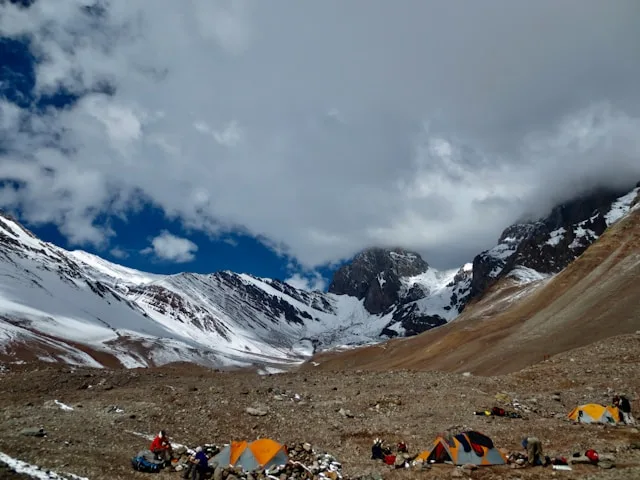
From Stok village, the trail climbs through the Stok Nala, a valley carved by glacial meltwater, past the summer settlement of Mankarmo, before reaching base camp at roughly 5,000 metres. Base camp itself is where the expedition genuinely begins in earnest — a full acclimatisation day here is standard practice, with short excursions to slightly higher elevations during daylight before returning to sleep at base camp, following the classic mountaineering principle of “climb high, sleep low.”
The summit push begins well before midnight, typically between 1 and 3 a.m., timed so that the final approach and summit itself are reached around or shortly after sunrise, before daytime warming softens the snow and increases rockfall risk on the upper slopes. The route crosses a glacier requiring crampons and, on the final summit ridge, a fixed rope is typically used for safety even though the terrain itself isn’t technically difficult in a climbing sense — the real challenge is entirely about altitude, cold, and sustained effort at over 6,000 metres with roughly half the oxygen available at sea level.
The summit itself, when reached, delivers one of the widest 360-degree panoramas available anywhere in Ladakh: the Indus valley and Leh spread out far below, the Zanskar range to the south, and on exceptionally clear mornings, distant glimpses of the Karakoram to the north. The descent back to base camp and eventually to Stok village typically happens the same day or the following morning, a long and tiring end to what is, physiologically, the most demanding single day most trekkers will have experienced.
Because the summit sits above 6,000 metres, altitude sickness risk is a serious and constant consideration throughout, and expedition leaders carry supplemental oxygen and maintain close medical monitoring, with turn-around decisions made firmly and without exception when conditions or individual health warrant it. This is a trek strictly for those with prior experience above 5,000 metres and a realistic, honest assessment of their own fitness.
Arrive in Leh (3,500m). Complete rest.
Local monastery visits and short acclimatisation walks.
Drive to Stok village, trek to the summer settlement of Mankarmo.
Continue up the valley to base camp (5,000m).
Acclimatisation day with a short excursion to a higher point before returning to base camp.
Pre-dawn summit push to Stok Kangri (6,153m), return to base camp the same day.
Weather/health contingency day for the summit push.
Descend to Stok village and drive back to Leh.
Departure from Leh.
Ladakh's most iconic village-to-village trek crosses two high passes and follows the Markha river past whitewashed monasteries, all…
Ladakh's gentlest trek — often called the 'baby trek' — links whitewashed gompas and willow-lined villages across the…