
Moderate
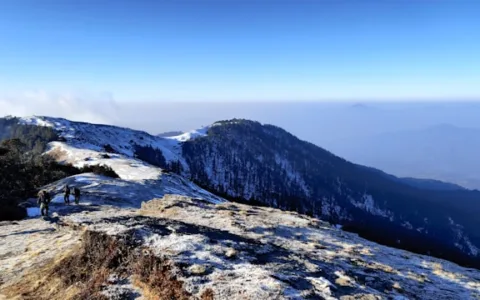
Brahmatal Trek
A winter wonderland trek to a sacred frozen lake, framed by uninterrupted views of Mt. Trishul and Nanda…
No trek in the world carries quite the name recognition of the Everest Base Camp trek, and for good reason — this is the route that follows in the footsteps of the earliest Everest expeditions, threading through the Khumbu Valley’s Sherpa villages and Buddhist monasteries to reach the foot of the world’s highest mountain at 8,849 metres. Unlike the mountain’s summit, reserved for trained mountaineers, base camp itself is a genuinely achievable, if demanding, goal for well-conditioned trekkers with no technical climbing experience required.
The trek begins with one of the most talked-about short flights anywhere in aviation — into Lukla’s Tenzing-Hillary Airport, a short, steeply angled runway wedged into a mountainside at 2,860 metres, considered among the more dramatic commercial airstrips in the world. From Lukla, the trail follows the Dudh Kosi river through Phakding and up towards Namche Bazaar, the unofficial capital of the Khumbu region and the last significant town before the trail turns properly high-altitude.
Namche itself, built in a natural amphitheatre carved into the hillside, has grown from a simple trading post into a genuine Sherpa hub, with bakeries, gear shops, and a Saturday market that still draws traders from across the region much as it has for generations. Most itineraries schedule a mandatory acclimatisation day here, using the extra time for a short hike to the Everest View Hotel or the Sherpa Culture Museum, both offering some of the first direct sightlines to Everest itself, still nearly a week’s walk away.
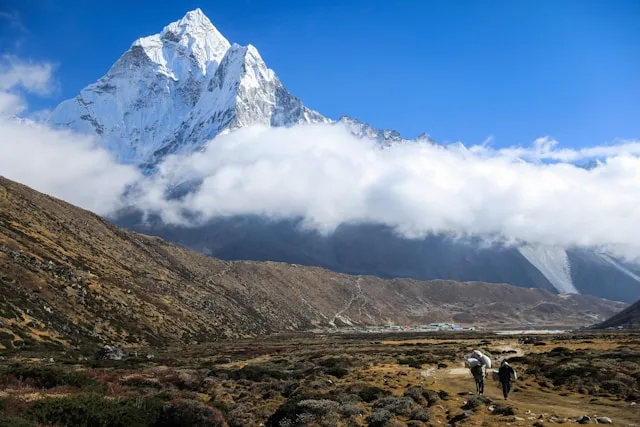
Beyond Namche, the trail passes through Tengboche, home to the region’s most significant monastery, where monks perform daily prayer ceremonies that trekkers are often welcomed to observe, with Ama Dablam’s strikingly sharp summit rising directly behind the monastery courtyard. This section of the trek moves through a landscape that is as much a living cultural corridor as a mountain trail — mani walls, prayer flags, and chortens mark nearly every significant point along the route, reflecting the deeply Buddhist character of Sherpa life in the Khumbu.
The final days of the approach, through Dingboche, Lobuche, and Gorak Shep, take the trek above 5,000 metres and into genuinely stark, high-altitude terrain, with the Khumbu Glacier’s chaotic icefall visible for much of the final stretch. Base camp itself, a shifting expanse of rock and ice at roughly 5,364 metres, is busiest during the spring climbing season when full mountaineering expeditions establish their camps here, giving trekkers arriving on foot a rare glimpse into the logistics of a genuine Everest summit attempt.
Most itineraries also include a climb to Kala Patthar, a nearby viewpoint at 5,644 metres that, unlike base camp itself, offers a genuinely clear, unobstructed view of Everest’s summit pyramid — widely considered the trek’s true visual highlight. Given the sustained altitude, prior high-altitude experience and a conservative, well-paced itinerary with adequate acclimatisation days are essential, and this is a trek that rewards patience and caution considerably more than raw fitness alone.
Fly from Kathmandu to Lukla (2,860m), trek to Phakding village.
Trek along the Dudh Kosi river, entering Sagarmatha National Park, to Namche Bazaar (3,440m).
Acclimatisation day with a hike to the Everest View Hotel or Sherpa Culture Museum.
Trek to Tengboche monastery (3,860m), with views of Ama Dablam.
Descend and climb through rhododendron forest to Dingboche (4,410m).
Acclimatisation hike towards Nangkartshang peak.
Trek across high, open terrain to Lobuche (4,940m).
Trek to Gorak Shep, continue to Everest Base Camp (5,364m), return to Gorak Shep.
Pre-dawn climb to Kala Patthar (5,644m) for Everest views, descend to Pheriche.
Descend back through Tengboche towards Namche Bazaar.
Final descent back to Lukla.
Weather contingency day for the Lukla flight.
Fly from Lukla back to Kathmandu.
Departure from Kathmandu.
A winter wonderland trek to a sacred frozen lake, framed by uninterrupted views of Mt. Trishul and Nanda…
A gentle cultural trek through the UNESCO-listed rice fields and pine-dotted hills of the Apatani tribal homeland in…
Kasol Tosh Kheerganga Trek Once you arrive in Kasol Tosh Kheerganga, you'll be greeted by the serene surroundings…