
Moderate
Siddarbetaa Trek
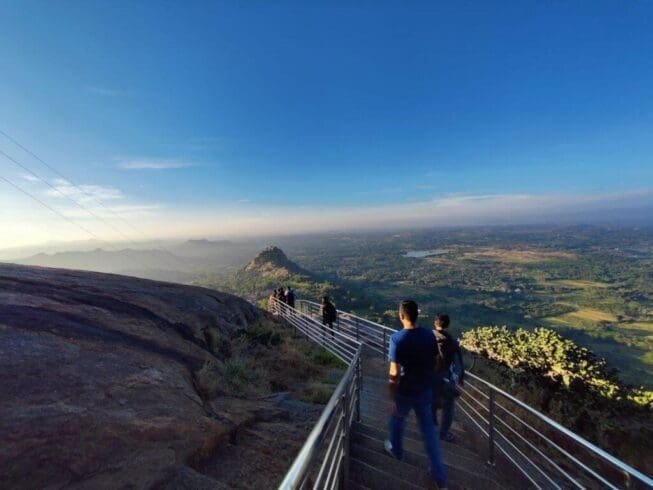
Siddara Betta Trek: Where Spirituality Meets Adventure Nestled in the heart of Karnataka, Siddara Betta stands as a…
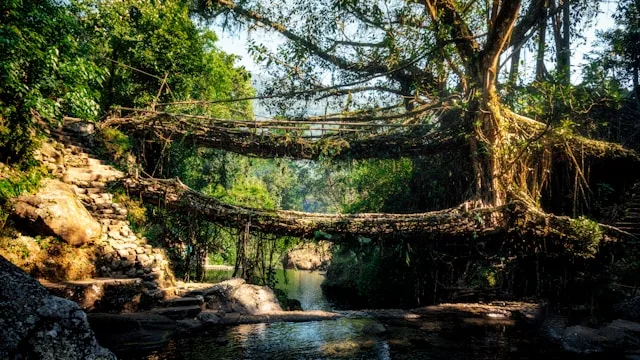
Few structures anywhere in the world are quite as unusual as Meghalaya’s living root bridges — functional footbridges grown, not built, by training the aerial roots of the Ficus elastica rubber tree across a river over the course of fifteen to thirty years, guided along bamboo scaffolding by the Khasi and Jaintia communities of this stretch of Northeast India until the roots themselves become strong enough to bear weight. The most famous of these, the double-decker bridge near Nongriat village, stacks two such living structures one above the other, and remains in active daily use by villagers centuries after the oldest sections were first trained into place.
The trek begins at Tyrna village, near Cherrapunji — a region that holds the record for some of the highest recorded annual rainfall anywhere on Earth, a climatic extreme that shapes every aspect of this trek’s character. The descent to Nongriat follows a stone staircase of somewhere between three and four thousand steps, carved and maintained by generations of local villagers, dropping steeply through dense subtropical rainforest into the gorge below — a genuinely demanding descent that, notably, becomes considerably more challenging on the return climb.
Along the way, the trail passes several smaller single-tier root bridges, each a testament to the same patient, decades-long cultivation process, and the Khasi tradition of viewing infrastructure not as something built once and left static, but as something grown, tended, and passed down across generations — bridges here are inherited, strengthened over time, and, unlike constructed spans, only become more robust rather than more fragile with age, provided the living roots continue to be guided and cared for by the community.
Nongriat village itself, reached after the steep descent, sits in a genuinely remote gorge setting, its small population sustained partly by the steady stream of trekkers drawn specifically to see the double-decker bridge, and partly by traditional betel nut and other cash crop cultivation suited to the region’s intensely wet climate. Homestay accommodation here, run by local Khasi families, gives trekkers a rare overnight window into a matrilineal society — Khasi inheritance and clan lineage passes through the mother’s line, a social structure distinct from most of the rest of India and one that shapes daily village life in ways visible even to a brief visitor.
Beyond the double-decker bridge itself, the Nongriat area offers several additional short excursions well suited to a second day — Rainbow Falls, a waterfall dropping into a turquoise natural pool that, on sunny afternoons, genuinely produces visible rainbows in its spray, and several other single root bridges scattered through the surrounding forest, each slightly different in design and age.
Because the trek’s defining challenge is entirely about the sheer number of steps rather than altitude or technical terrain, physical conditioning matters more here than prior high-altitude trekking experience — the descent is manageable for most reasonably fit visitors, but the climb back out of the gorge, particularly in Meghalaya’s characteristic humidity, is genuinely demanding and should not be underestimated.
For trekkers seeking something entirely distinct from India’s mountain trekking traditions — a living, centuries-old engineering tradition set within one of the wettest and most biodiverse corners of the country — the Nongriat root bridge trek offers a genuinely unique reward found nowhere else in India, or arguably anywhere else in the world.
Descend the stone staircase from Tyrna through rainforest to Nongriat village, visit the double-decker living root bridge, overnight homestay.
Short trek to Rainbow Falls, climb back up the staircase to Tyrna and drive to Cherrapunji/Shillong.
Siddara Betta Trek: Where Spirituality Meets Adventure Nestled in the heart of Karnataka, Siddara Betta stands as a…
The Bhrigu Lake Trek, located in the picturesque state of Himachal Pradesh, is a renowned trekking destination that…
A remote Kumaon expedition to the base of five sacred peaks said to mark the Pandavas' final cooking…