
Moderate
Friendship Peak Expedition
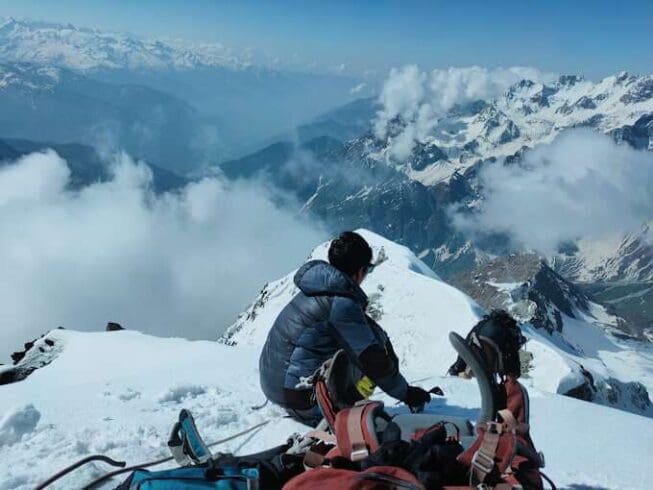
Friendship Peak Expedition Friendship Peak, standing tall at an elevation of 5,289 meters (17,356 feet) in the Pir…
Pachmarhi Trek runs 3 days in India, graded Easy, from Rs 3,500 per person.
Water is a defining feature of the Pachmarhi landscape, with numerous waterfalls tucked into narrow sandstone gorges across the plateau — Bee Falls, Duchess Falls, and Rajat Prapat among the most visited, each reached via short forest trails that showcase the region’s dense sal and teak forest cover. Sitting atop the Satpura range within the Pachmarhi Biosphere Reserve, the plateau offers a genuinely different trekking landscape from anywhere further north or south: sandstone plateaus, hidden waterfalls carved into soft rock, and one of the largest concentrations of prehistoric rock art found anywhere in India. Pachmarhi holds a distinctive status as Madhya Pradesh’s only hill station and, more broadly, one of the very few significant hill-trekking destinations in Central India — a region generally associated more with tiger reserves and ancient temple architecture than mountain trails. Scattered across the plateau and its surrounding cliffs are the Pachmarhi rock shelters — over 500 documented sites containing prehistoric cave paintings, some estimated to date back over 10,000 years, depicting hunting scenes, animals, and human figures in ochre and white pigment. The trek begins from Pachmarhi town itself, and unlike most Indian treks that climb steadily toward a single high point, this route moves largely across a relatively level plateau at around 1,100 metres, weaving between forest, grassland, and dramatic sandstone formations shaped by millions of years of water erosion. The surrounding Satpura Tiger Reserve and Pachmarhi Biosphere Reserve support a genuinely rich wildlife population, including tiger, leopard, Indian bison (gaur), and a wide range of deer species, though core zone wildlife viewing typically requires a separate vehicle safari rather than the trekking trails themselves, which stay largely within buffer zone and heritage areas designated for foot access.
Pachmarhi is the highest point in Madhya Pradesh, sitting at about 1,067 m in the Satpura range. The area is a biosphere reserve and holds the Satpura tiger reserve on its fringes. Dhoopgarh is the highest summit in the Pachmarhi plateau and is known for its sunset view. The walking here is a mix of plateau trails, ravines and waterfall paths rather than a single summit route. Bee Falls and Apsara Vihar are among the waterfall stops on the standard circuit. The Pandav Caves, a group of rock-cut shelters, sit on the plateau edge. Pipariya is the nearest railhead, about 47 km away, and Bhopal the nearest large airport.
At this height the limit on the Pachmarhi Trek is fitness and heat rather than oxygen, which makes the descent the part people underestimate.
The Pachmarhi Trek is a realistic first outing, since its 3 days are short enough that fitness is not the barrier. Families with older children and anyone returning to walking after a break fit the Pachmarhi Trek comfortably. Solo travellers move inside a led group on the Pachmarhi Trek, so the pace is collective rather than personal.
Heat and sun are bigger risks than cold on the Pachmarhi Trek, so a cap, sunscreen and more water than feels necessary matter most. Footwear decides the day on the Pachmarhi Trek: loose stone and wet ground cause most slips, and a worn sole is the usual reason people struggle on the descent. Carry two litres of water each on the Pachmarhi Trek, a small first-aid kit, a head torch for pre-dawn walking, and food already tested on a training walk.
The main risks on the Pachmarhi Trek at this height are slips on wet sections and dehydration on exposed stretches, both prevented by steady pacing. A certified leader carries first aid and safety kit on the Pachmarhi Trek and reviews the forecast each morning, so the plan stays provisional until conditions are known. Travel insurance that covers trekking at this altitude is worth the small extra cost and is not part of the Pachmarhi Trek price.
The Rs 3,500 price of the Pachmarhi Trek covers accommodation on the itinerary, the listed meals, a certified leader with support crew, applicable permits and entry fees, and the safety equipment carried. Excluded from the Pachmarhi Trek are travel to the assembly point unless the itinerary says otherwise, personal kit and clothing, insurance, and anything the inclusions list does not name.
For visitors exploring Central India’s tiger reserves and historic sites, Pachmarhi offers a genuinely worthwhile, low-difficulty trekking addition — a landscape combining ancient rock art, sandstone gorge waterfalls, and the Satpura range’s highest viewpoint, in a part of the country rarely associated with trekking at all. Rajat Prapat, the tallest of these at over 100 metres, requires a longer, moderately steep descent into its gorge, offering the trek’s most physically engaging single stretch, though still well within reach of moderately fit visitors. This concentration of ancient rock art, recognised by UNESCO on its tentative World Heritage list, gives Pachmarhi’s trails a genuinely rare archaeological dimension alongside their natural scenery, and several of the most accessible shelters are included as stops along the standard trekking routes. This gentler topography is a large part of what makes Pachmarhi accessible to a genuinely broad range of visitors, from families to first-time trekkers, without sacrificing a real sense of wilderness immersion.
Browsing by region or activity is often faster than reading individual pages, so start with Madhya Pradesh.
Pachmarhi holds a distinctive status as Madhya Pradesh’s only hill station and, more broadly, one of the very few significant hill-trekking destinations in Central India — a region generally associated more with tiger reserves and ancient temple architecture than mountain trails. Sitting atop the Satpura range within the Pachmarhi Biosphere Reserve, the plateau offers a genuinely different trekking landscape from anywhere further north or south: sandstone plateaus, hidden waterfalls carved into soft rock, and one of the largest concentrations of prehistoric rock art found anywhere in India.
The trek begins from Pachmarhi town itself, and unlike most Indian treks that climb steadily toward a single high point, this route moves largely across a relatively level plateau at around 1,100 metres, weaving between forest, grassland, and dramatic sandstone formations shaped by millions of years of water erosion. This gentler topography is a large part of what makes Pachmarhi accessible to a genuinely broad range of visitors, from families to first-time trekkers, without sacrificing a real sense of wilderness immersion.
Scattered across the plateau and its surrounding cliffs are the Pachmarhi rock shelters — over 500 documented sites containing prehistoric cave paintings, some estimated to date back over 10,000 years, depicting hunting scenes, animals, and human figures in ochre and white pigment. This concentration of ancient rock art, recognised by UNESCO on its tentative World Heritage list, gives Pachmarhi’s trails a genuinely rare archaeological dimension alongside their natural scenery, and several of the most accessible shelters are included as stops along the standard trekking routes.
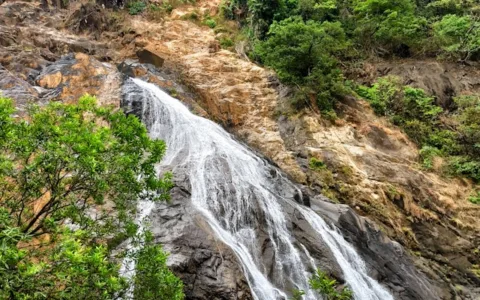
Water is a defining feature of the Pachmarhi landscape, with numerous waterfalls tucked into narrow sandstone gorges across the plateau — Bee Falls, Duchess Falls, and Rajat Prapat among the most visited, each reached via short forest trails that showcase the region’s dense sal and teak forest cover. Rajat Prapat, the tallest of these at over 100 metres, requires a longer, moderately steep descent into its gorge, offering the trek’s most physically engaging single stretch, though still well within reach of moderately fit visitors.
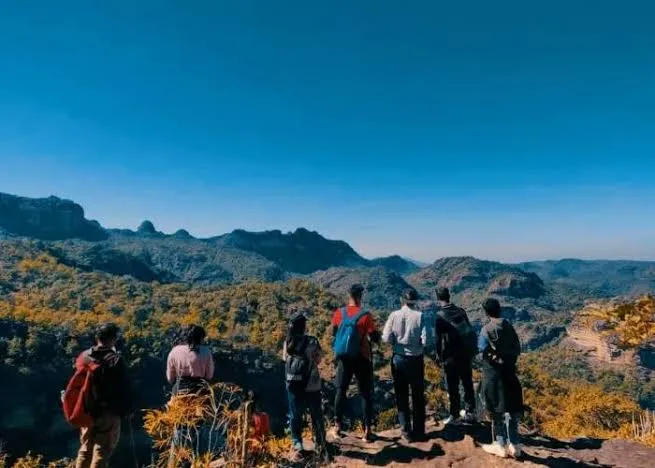
Dhoopgarh, the highest point in the Satpura range at 1,352 metres, anchors the trek’s high point both literally and experientially — a plateau-edge viewpoint particularly renowned for sunset, when the layered ridgelines of the Satpuras fade into successive shades of blue and purple toward the horizon, a view considered among the finest in Central India despite the range’s comparatively modest overall elevation.
The surrounding Satpura Tiger Reserve and Pachmarhi Biosphere Reserve support a genuinely rich wildlife population, including tiger, leopard, Indian bison (gaur), and a wide range of deer species, though core zone wildlife viewing typically requires a separate vehicle safari rather than the trekking trails themselves, which stay largely within buffer zone and heritage areas designated for foot access.
For visitors exploring Central India’s tiger reserves and historic sites, Pachmarhi offers a genuinely worthwhile, low-difficulty trekking addition — a landscape combining ancient rock art, sandstone gorge waterfalls, and the Satpura range’s highest viewpoint, in a part of the country rarely associated with trekking at all.
The Pachmarhi Trek runs for 3 days. The day-by-day itinerary above lists each stage, walking distance and overnight stay.
The Pachmarhi Trek is rated Easy by WDRLUST. It suits first-time trekkers with reasonable fitness. Training with 45 to 60 minutes of cardio three times a week for six weeks before departure is enough for most people.
The Pachmarhi Trek starts at Rs 3,500 per person. The price covers the inclusions listed on this page. Transport to the starting point, personal gear and anything not listed under inclusions are extra.
The route reaches approximately 1,100 m. Walk slowly, drink water and report any headache or nausea to your trek leader.
Group size is capped at Max 18 trekkers per departure, with a certified trek leader. Smaller groups mean faster head counts and more attention on the trail.
The Pachmarhi Trek starts from the base location described in the itinerary above. WDRLUST shares exact meeting points, reporting times and transport options on booking confirmation. The nearest major access region is Madhya Pradesh.
Pachmarhi is the hill station in the Satpura range of Madhya Pradesh, and the three-day trek format links its waterfalls, caves and plateau viewpoints. It is the only central Indian trek on this site and the easiest to reach from Bengaluru by train.
The trek fee is Rs 3,500 per person:
Expect Rs 6,000 to Rs 9,000 all-in. This is the cheapest trek to reach from Bengaluru in terms of total spend, because the train replaces the flight.
Rated Easy. The walking is 5 to 8 km a day on plateau paths and forest tracks, with the highest point around 1,350 m. There is no altitude and no technical ground.
This is a walking trip rather than a mountain trek, and that is its virtue: it is achievable for almost anyone, and the combination of Bee Falls, Jata Shankar and the Dhoopgarh sunset makes it a genuine holiday rather than a training exercise.
The Satpura plateau gets a proper monsoon, and the waterfalls that are dry in April become torrents in August. The cave sections and the stepped paths become slippery, and leeches appear on the forest trails.
The monsoon is the more scenic option here precisely because the water features come alive. If you want the walking to be easy, go in November; if you want the waterfalls, go in August and accept the wet.
Take an overnight train from Bengaluru to Pipariya or Itarsi, then a short road transfer to Pachmarhi. Trek two or three days and return on the overnight train. That is four or five nights away from Bengaluru, and no flights are required.
Explore related pages: All treks in Madhya Pradesh · Browse all destinations · All activities.
Arrive at Pachmarhi. Visit nearby rock shelters and Bee Falls, briefing.
Trek across the plateau to Dhoopgarh for sunset views, visit Rajat Prapat waterfall via the gorge trail.
Short trek to Duchess Falls and other rock shelter sites, departure from Pachmarhi.
Friendship Peak Expedition Friendship Peak, standing tall at an elevation of 5,289 meters (17,356 feet) in the Pir…
Kasol Grahan Trek – Explore the Hidden Trails of Parvati Valley If you’re looking for a trek that…
A monsoon-fed jungle trek along an active railway line to one of India's tallest waterfalls, straddling the Goa-Karnataka…