
Easy

Pongal Festival Tamil Nadu
Pongal Festival Tamil Nadu tour, 4D/3N from Madurai, graded Easy, from Rs 7,200. Bhogi, Thai Pongal, Mattu Pongal…
Next Departure
27/11/2026
16 seats left
Mukurthi Peak Trek runs 2 days in Kerala, graded Moderate, from Rs 3,800 per person.
Mukurthi Peak sits within Mukurthi National Park, a small but ecologically vital protected area in the Nilgiris established specifically to safeguard the Nilgiri tahr — a wild mountain goat found only in the higher reaches of the southern Western Ghats, and one of India’s most endangered large mammals. Trekking here is inseparable from that conservation purpose; access is tightly regulated, group sizes capped, and guides trained specifically to minimise disturbance to a species whose entire remaining habitat is confined to a handful of similar high-altitude grassland patches across Tamil Nadu and Kerala. For trekkers who have already explored the Western Ghats further north and want to see the range’s ecology at its most protected and pristine, Mukurthi offers a genuinely rare combination: rolling highland scenery, a real chance of spotting one of India’s rarest mammals, and a landscape shaped as much by conservation policy as by geology. The reward for trekking in this changeable weather is a genuine chance of spotting the Nilgiri tahr itself — small groups are occasionally visible grazing on the steep grassy slopes near the peak, their sure-footed movement across terrain that would challenge most other large mammals a distinctive sight found nowhere outside this specific stretch of the Western Ghats. Because access is permit-based and capped daily to protect the park’s fragile ecology, trekking here requires advance booking through the Tamil Nadu forest department, arranged well ahead of a planned visit, and independent access without both permit and registered guide is not permitted. Beyond the tahr, the park supports a range of other high-altitude specialists, including the Nilgiri marten and a rich diversity of montane bird species adapted to this cool, misty grassland environment.
Mukurthi Peak stands at about 2,554 m (8,380 ft) in the Nilgiri hills. The peak sits inside Mukurthi National Park, which requires forest permission to enter. The usual approach is from Avalanche, near Ooty, with a forest checkpoint at the park boundary. The park is known for its shola-grassland mosaic and for the Nilgiri tahr. The walk is graded moderate to difficult, with long grassland sections and no shade. Ooty is the base town, and the Nilgiri Mountain Railway connects it to Mettupalayam. The park limits entry, so permits are arranged in advance rather than on the day.
Around 2,554 m the air on the Mukurthi Peak Trek is thin enough to notice but not high enough to need acclimatisation days.
The Mukurthi Peak Trek suits people who already walk but have not necessarily trekked, since its 2 days ask for stamina rather than skill. A fit beginner who prepares gets through the Mukurthi Peak Trek; someone treating it as a stroll does not. Solo travellers move inside a led group on the Mukurthi Peak Trek, so the pace is collective rather than personal.
Mornings on the Mukurthi Peak Trek are cold and afternoons warm quickly at 2,554 m, so a light fleece plus a shell covers almost everything. Footwear decides the day on the Mukurthi Peak Trek: loose stone and wet ground cause most slips, and a worn sole is the usual reason people struggle on the descent. Carry two litres of water each on the Mukurthi Peak Trek, a small first-aid kit, a head torch for pre-dawn walking, and food already tested on a training walk.
The main risks on the Mukurthi Peak Trek at this height are slips on wet sections and dehydration on exposed stretches, both prevented by steady pacing. A certified leader carries first aid and safety kit on the Mukurthi Peak Trek and reviews the forecast each morning, so the plan stays provisional until conditions are known. Travel insurance that covers trekking at this altitude is worth the small extra cost and is not part of the Mukurthi Peak Trek price.
The Rs 3,800 price of the Mukurthi Peak Trek covers accommodation on the itinerary, the listed meals, a certified leader with support crew, applicable permits and entry fees, and the safety equipment carried. Excluded from the Mukurthi Peak Trek are travel to the assembly point unless the itinerary says otherwise, personal kit and clothing, insurance, and anything the inclusions list does not name.
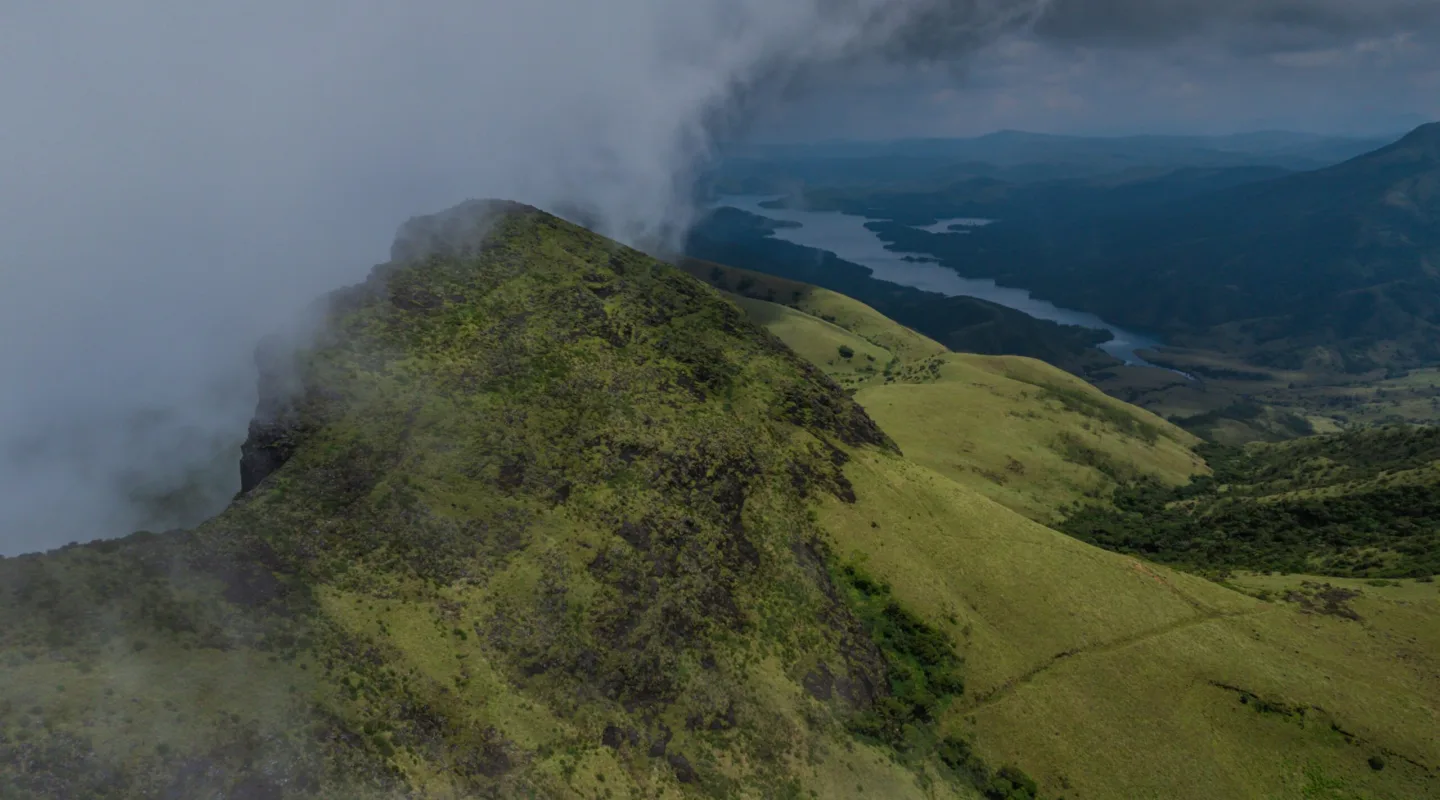
Mist and wind are constant companions on this trek, often arriving with little warning even during otherwise clear stretches of weather, a product of the Nilgiris’ position catching both the southwest and northeast monsoon systems across the year. Stunted, gnarled shola forest fills the sheltered valley folds, while open rolling grassland covers the exposed ridgelines, a pattern shaped by centuries of fire, grazing, and the region’s distinct montane climate. Local guides read these conditions closely, since visibility across the open grassland can drop to a few metres within minutes, and navigation without genuine local knowledge of the terrain is neither advisable nor, in most cases, permitted by the forest department.
Browsing by region or activity is often faster than reading individual pages, so start with Tamil Nadu. The closest alternatives to the Mukurthi Peak Trek are Chembra Peak Trek, which suit anyone comparing dates or a slightly different grade.
Mukurthi Peak sits within Mukurthi National Park, a small but ecologically vital protected area in the Nilgiris established specifically to safeguard the Nilgiri tahr — a wild mountain goat found only in the higher reaches of the southern Western Ghats, and one of India’s most endangered large mammals. Trekking here is inseparable from that conservation purpose; access is tightly regulated, group sizes capped, and guides trained specifically to minimise disturbance to a species whose entire remaining habitat is confined to a handful of similar high-altitude grassland patches across Tamil Nadu and Kerala.
The trek begins near Mukurthi Peak’s base, reached via the hill town of Ooty and the Nilgiris’ famously winding ghat roads, and immediately enters the shola-grassland ecosystem that defines the park — the same distinctive vegetation mosaic found at Kudremukh and Chembra further north, but here at its most pristine and least disturbed, owing directly to the park’s strict protective status. Stunted, gnarled shola forest fills the sheltered valley folds, while open rolling grassland covers the exposed ridgelines, a pattern shaped by centuries of fire, grazing, and the region’s distinct montane climate.
Mist and wind are constant companions on this trek, often arriving with little warning even during otherwise clear stretches of weather, a product of the Nilgiris’ position catching both the southwest and northeast monsoon systems across the year. Local guides read these conditions closely, since visibility across the open grassland can drop to a few metres within minutes, and navigation without genuine local knowledge of the terrain is neither advisable nor, in most cases, permitted by the forest department.
The reward for trekking in this changeable weather is a genuine chance of spotting the Nilgiri tahr itself — small groups are occasionally visible grazing on the steep grassy slopes near the peak, their sure-footed movement across terrain that would challenge most other large mammals a distinctive sight found nowhere outside this specific stretch of the Western Ghats. Beyond the tahr, the park supports a range of other high-altitude specialists, including the Nilgiri marten and a rich diversity of montane bird species adapted to this cool, misty grassland environment.
Mukurthi Peak itself, at 2,554 metres one of the highest points in Tamil Nadu, offers on clearer mornings a wide view across the Nilgiri plateau and, toward the west, glimpses down into the steep escarpment that drops sharply toward the Kerala lowlands — a genuinely dramatic elevation change compressed into a comparatively short horizontal distance, characteristic of the Western Ghats’ escarpment geography.
Because access is permit-based and capped daily to protect the park’s fragile ecology, trekking here requires advance booking through the Tamil Nadu forest department, arranged well ahead of a planned visit, and independent access without both permit and registered guide is not permitted. For trekkers who have already explored the Western Ghats further north and want to see the range’s ecology at its most protected and pristine, Mukurthi offers a genuinely rare combination: rolling highland scenery, a real chance of spotting one of India’s rarest mammals, and a landscape shaped as much by conservation policy as by geology.
The Mukurthi Peak Trek runs for 2 days. The day-by-day itinerary above lists each stage, walking distance and overnight stay.
The Mukurthi Peak Trek is rated Moderate by WDRLUST. It suits trekkers with some prior walking experience and steady fitness. Training with 45 to 60 minutes of cardio three times a week for six weeks before departure is enough for most people.
The Mukurthi Peak Trek starts at Rs 3,800 per person. The price covers the inclusions listed on this page. Transport to the starting point, personal gear and anything not listed under inclusions are extra.
The route reaches approximately 2,554 m. Walk slowly, drink water and report any headache or nausea to your trek leader.
Group size is capped at Max 15 trekkers per departure, with a certified trek leader. Smaller groups mean faster head counts and more attention on the trail.
The Mukurthi Peak Trek starts from the base location described in the itinerary above. WDRLUST shares exact meeting points, reporting times and transport options on booking confirmation. The nearest major access region is Tamil Nadu.
Mukurthi sits inside Mukurthi National Park above Ooty, in shola-grassland that is protected and tightly permitted. It is one of the higher South Indian walks at over 2,500 m, and its weather is Nilgiris weather: capable of four seasons in an afternoon.
The trek fee is Rs 3,800 per person for the two-day format:
Plan on Rs 7,000 to Rs 9,500 all-in. Ooty hotel rates spike in April and May, which is worth knowing if your dates are flexible.
Rated Moderate. The walking is around 10 to 12 km with a few hundred metres of gain, and the terrain is rolling grassland rather than a single steep push. What makes it feel harder is the altitude and the wind: you are above 2,400 m for most of the day on open ground with no tree cover.
Bengaluru trekkers usually find the distance easy and the exposure surprising. Carry a windproof layer even in February, because the ridge wind is constant and cold.
Rain in the Nilgiris arrives fast and reduces visibility to a few metres, which on open grassland with indistinct paths is a genuine navigation problem. Groups are led, so the risk is managed, but you should expect to be walking in cloud at some point between June and September.
The shola patches get muddy and the grass holds water, so waterproof boots matter more than on a granite hill. Lightning on exposed grassland is the condition that ends a day early.
Overnight bus or Friday drive to Ooty, acclimatise on Saturday with the trek, and return on Sunday. Because the park operates on permits with limited numbers, book well ahead rather than planning this as a spontaneous weekend. Also budget for the Ooty traffic on weekends, which can add an hour to any local transfer.
Explore related pages: All treks in Tamil Nadu · Kodaikanal destination guide · Browse all destinations · All activities.
Drive from Ooty to the park entrance, permit verification, trek into the shola-grassland to a designated campsite.
Early trek to Mukurthi Peak (2,554m) for views and a chance of spotting Nilgiri tahr, descend and drive back to Ooty.
Pongal Festival Tamil Nadu tour, 4D/3N from Madurai, graded Easy, from Rs 7,200. Bhogi, Thai Pongal, Mattu Pongal…
Velliangiri Hills Trek, 2D/1N from Coimbatore. Seven consecutive hills, a cave camp at the fifth and sunrise from…
Overview of the Kodaikanal Group Trip from Bangalore Kodaikanal Group Trip from Bangalore runs 1N/2D from Bangalore, graded…