
Difficult
Rupin Pass Trek
A dramatic high-altitude crossing linking Uttarakhand and Himachal, famous for its hanging villages, a near-vertical snow wall, and…
Chopta has earned a reputation, somewhat hyperbolically but not entirely without reason, as the “Mini Switzerland of India” — a small meadow-village surrounded by rolling grassland and dense conifer forest, sitting at a comfortable enough altitude that it works as a base for one of Uttarakhand’s most rewarding short treks. In just four days, this route delivers a visit to the highest Shiva temple in the world, an alpine meadow ablaze with rhododendron in spring, and a sunrise summit view that rivals treks many times longer and harder.
The trek’s first major landmark is Tungnath temple, part of the revered Panch Kedar circuit of five Shiva temples in Garhwal, and, at roughly 3,680 metres, the highest temple dedicated to Shiva anywhere in the world. Local legend holds that the Pandava brothers built the temple after the events of the Mahabharata, and the current stone structure, though rebuilt several times over the centuries, is believed to date back over a thousand years. Pilgrims and trekkers climb the same path together here, and it’s common to see both groups pause at the temple courtyard regardless of which brought them up the mountain.
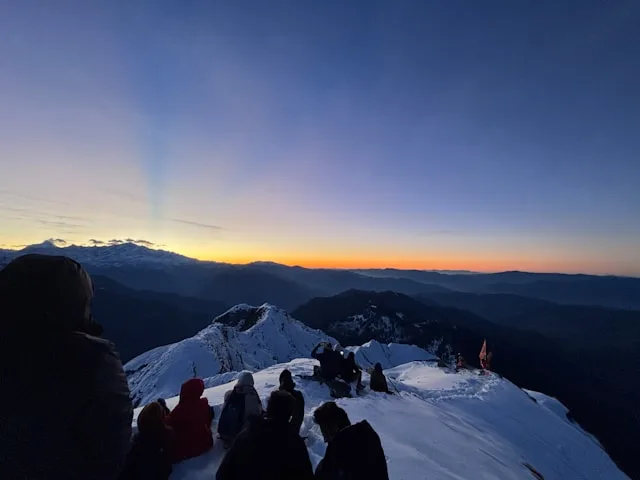
Beyond Tungnath, a further climb of roughly ninety minutes leads to Chandrashila summit at 3,680 metres — the trek’s true highlight. Unlike many Himalayan summit points that require a multi-day approach through remote wilderness, Chandrashila is reachable as a single push from Chopta, making its panoramic reward remarkably efficient to access: an unbroken 360-degree sweep that includes Nanda Devi, Trishul, Kedarnath, Bandarpoonch, and Chaukhamba, all visible together on a clear morning. Most trekkers time their ascent for sunrise specifically, when the entire range catches first light in sequence, peak by peak.
The trail itself passes through the Kedarnath Wildlife Sanctuary, home to the Himalayan monal — India’s most striking high-altitude pheasant, with iridescent plumage that shifts colour depending on the angle of light — along with musk deer and, at higher elevations, occasional sightings of Himalayan black bear. Rhododendron forest dominates the lower stretches of the trail, turning entire hillsides crimson through April and May, while the meadows immediately around Chopta itself remain a soft green through much of the trekking season.
Because the trek involves only a modest elevation gain spread across short daily distances, it’s graded easy and works well as an introduction to Himalayan trekking, a family-friendly option for trekkers with children or older members, or simply a compact escape for those with limited time but a genuine appetite for high-altitude scenery. Winter transforms the same route into a snow trek, with Chopta regularly recording some of the best snowfall in the region between December and February, adding a completely different, quieter character to the same trail.
Deoriatal lake, a short detour from the main route, is sometimes added as an extension for trekkers with an extra day to spare, offering a still, forest-ringed reflection of the same Chaukhamba massif visible from Chandrashila’s summit — a fitting, gentler bookend to a trek that manages to deliver an outsized Himalayan experience in a genuinely short window.
Arrive at Chopta (2,680m). Short acclimatisation walk and briefing.
Trek to Tungnath temple, continue to Chandrashila summit (3,680m) for panoramic views, descend to Chopta.
Optional visit to Deoriatal lake or leisure day exploring Chopta meadows.
Departure from Chopta.
A dramatic high-altitude crossing linking Uttarakhand and Himachal, famous for its hanging villages, a near-vertical snow wall, and…
A challenging high-altitude crossing linking the Har Ki Dun and Yamunotri valleys, culminating in a steep, technical pass…
A remote Kumaon expedition to the base of five sacred peaks said to mark the Pandavas' final cooking…