Easy
Deoriatal Chandrashila Trek
A four-day trek that opens with a mirror-still Himalayan lake and closes with a sunrise summit view spanning…
Bali Pass Trek runs 8 days in Uttarakhand, graded Difficult, from Rs 15,500 per person.
Bali Pass is, in many ways, an extension of the classic Har Ki Dun trek pushed considerably further — instead of turning back from the valley meadow, this route continues up and over a genuinely demanding high-altitude pass at 4,950 metres, descending on the far side into the Yamunotri valley near the source of the Yamuna river. The first several days retrace familiar territory: Sankri, Taluka, and the wood-carved village of Osla, with its temple to Duryodhana, before reaching the Har Ki Dun meadow itself beneath the Swargarohini peaks. The descent into the Yamunotri side is steep and demanding in its own right, dropping through Ruinsara Tal — a beautiful, lesser-visited alpine lake ringed by meadow and forest, often used as a rest stop before the final push down to the Yamunotri road head. From the pass summit, the reward is a view that spans both valleys the trek connects — Swargarohini and the Har Ki Dun basin behind, and the beginnings of the Yamunotri valley ahead, with Bandarpoonch’s massif dominating the skyline to the south. Ruinsara Tal, despite sitting on one of the more difficult trek routes in the region, is calm and gentle in character, a deliberate contrast built into most itineraries to give trekkers a recovery day after the intensity of the pass crossing itself. Because Bali Pass combines sustained high-altitude exposure, a technical and weather-dependent crossing, and total remoteness for several days at a stretch — evacuation from the pass area is difficult and slow — this trek is recommended only for those with prior high-altitude trekking experience and a realistic level of fitness.
At 4,950 m the thin air is the real constraint on the Bali Pass Trek, so the upper stretch is walked slowly and altitude symptoms are reported early.
The Bali Pass Trek is not a first trip; its 8 days demand a base of regular walking before you commit. Experienced trekkers and well-prepared first-timers are the right audience for the Bali Pass Trek, and a spontaneous weekend is a poor substitute for training. Solo travellers move inside a led group on the Bali Pass Trek, so the pace is collective rather than personal.
Layers do more work than any single jacket on the Bali Pass Trek, because the temperature at 4,950 m bears little relation to the trailhead. Footwear decides the day on the Bali Pass Trek: loose stone and wet ground cause most slips, and a worn sole is the usual reason people struggle on the descent. Carry two litres of water each on the Bali Pass Trek, a small first-aid kit, a head torch for pre-dawn walking, and food already tested on a training walk.
At 4,950 m on the Bali Pass Trek, altitude illness is the main risk rather than the ground, so walk slowly and report a persistent headache or nausea immediately. A certified leader carries first aid and safety kit on the Bali Pass Trek and reviews the forecast each morning, so the plan stays provisional until conditions are known. Travel insurance that covers trekking at this altitude is worth the small extra cost and is not part of the Bali Pass Trek price.
The Rs 15,500 price of the Bali Pass Trek covers accommodation on the itinerary, the listed meals, a certified leader with support crew, applicable permits and entry fees, and the safety equipment carried. Excluded from the Bali Pass Trek are travel to the assembly point unless the itinerary says otherwise, personal kit and clothing, insurance, and anything the inclusions list does not name.
From here, though, the route diverges sharply from the standard trek, climbing instead towards Odari and then a high camp positioned directly below the pass, where the terrain shifts from alpine meadow to loose scree, snowfield, and finally a steep, exposed climb to the pass itself. The crossing of Bali Pass is unambiguously the trek’s defining test. Weather at this altitude changes quickly and without much warning, and experienced operators build in buffer days specifically for this crossing, since a safe attempt depends heavily on clear conditions and stable snow — attempting the pass in poor visibility or after fresh snowfall is not something any responsible guide will risk. It’s a trek that rewards trekkers who already loved Har Ki Dun’s scenery but wanted a more serious physical and technical challenge layered on top of it. Few passes in the Garhwal Himalaya offer quite this dramatic a sense of transition, crossing in a single day from one storied valley system into another. For trekkers who meet that bar, though, it remains one of the most complete and rewarding pass crossings in the Garhwal Himalaya. The final approach involves a sustained, steep ascent over loose rock and often hard-packed snow, frequently requiring careful, guide-led movement with fixed ropes on the most exposed sections.
Browsing by region or activity is often faster than reading individual pages, so start with Uttarakhand. The closest alternatives to the Bali Pass Trek are Har Ki Dun Valley Trek, Brahmatal Trek and Rupin Pass Trek, which suit anyone comparing dates or a slightly different grade.
Bali Pass is, in many ways, an extension of the classic Har Ki Dun trek pushed considerably further — instead of turning back from the valley meadow, this route continues up and over a genuinely demanding high-altitude pass at 4,950 metres, descending on the far side into the Yamunotri valley near the source of the Yamuna river. It’s a trek that rewards trekkers who already loved Har Ki Dun’s scenery but wanted a more serious physical and technical challenge layered on top of it.
The first several days retrace familiar territory: Sankri, Taluka, and the wood-carved village of Osla, with its temple to Duryodhana, before reaching the Har Ki Dun meadow itself beneath the Swargarohini peaks. From here, though, the route diverges sharply from the standard trek, climbing instead towards Odari and then a high camp positioned directly below the pass, where the terrain shifts from alpine meadow to loose scree, snowfield, and finally a steep, exposed climb to the pass itself.
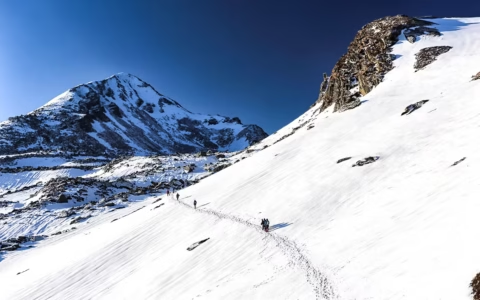
The crossing of Bali Pass is unambiguously the trek’s defining test. The final approach involves a sustained, steep ascent over loose rock and often hard-packed snow, frequently requiring careful, guide-led movement with fixed ropes on the most exposed sections. Weather at this altitude changes quickly and without much warning, and experienced operators build in buffer days specifically for this crossing, since a safe attempt depends heavily on clear conditions and stable snow — attempting the pass in poor visibility or after fresh snowfall is not something any responsible guide will risk.
From the pass summit, the reward is a view that spans both valleys the trek connects — Swargarohini and the Har Ki Dun basin behind, and the beginnings of the Yamunotri valley ahead, with Bandarpoonch’s massif dominating the skyline to the south. Few passes in the Garhwal Himalaya offer quite this dramatic a sense of transition, crossing in a single day from one storied valley system into another.
The descent into the Yamunotri side is steep and demanding in its own right, dropping through Ruinsara Tal — a beautiful, lesser-visited alpine lake ringed by meadow and forest, often used as a rest stop before the final push down to the Yamunotri road head. Ruinsara Tal, despite sitting on one of the more difficult trek routes in the region, is calm and gentle in character, a deliberate contrast built into most itineraries to give trekkers a recovery day after the intensity of the pass crossing itself.
Because Bali Pass combines sustained high-altitude exposure, a technical and weather-dependent crossing, and total remoteness for several days at a stretch — evacuation from the pass area is difficult and slow — this trek is recommended only for those with prior high-altitude trekking experience and a realistic level of fitness. For trekkers who meet that bar, though, it remains one of the most complete and rewarding pass crossings in the Garhwal Himalaya.
The Bali Pass Trek runs for 8 days. The day-by-day itinerary above lists each stage, walking distance and overnight stay.
The Bali Pass Trek is rated Difficult by WDRLUST. It demands strong fitness, prior high-altitude experience and good acclimatisation. Training with 45 to 60 minutes of cardio three times a week for six weeks before departure is enough for most people.
The Bali Pass Trek starts at Rs 15,500 per person. The price covers the inclusions listed on this page. Transport to the starting point, personal gear and anything not listed under inclusions are extra.
The route reaches approximately 4,950 m. Walk slowly, drink water and report any headache or nausea to your trek leader.
Group size is capped at Max 12 trekkers per departure, with a certified trek leader. Smaller groups mean faster head counts and more attention on the trail.
The Bali Pass Trek starts from the base location described in the itinerary above. WDRLUST shares exact meeting points, reporting times and transport options on booking confirmation. The nearest major access region is Uttarakhand.
Bali Pass at 4,950 m crosses between the Tons valley and the Yamuna side in Uttarakhand, and it is one of the harder Himalayan crossings. Eight days, a glacier section, and a genuine sense of remoteness.
The trek fee is Rs 15,500 per person:
Plan on Rs 32,000 to Rs 42,000 all-in. Eight supported days and a traverse exit push the fee up compared with an out-and-back trek of similar length.
Rated Difficult. The route involves a glacier crossing, steep scree, and a sustained pass day, with several days spent above 4,000 m. This is not a trek for a first Himalayan outing.
The traverse adds commitment: once over the pass you exit on a different side, so retreat is not simple. Prior experience at 4,500 m and comfort on snow are the minimum qualifications.
On the pass the concern is snow conditions and the stability of the slope below it. Fresh snow raises avalanche concern and can hold a group at camp. The descent on the far side is steep and loose, and wet conditions make it slow.
In the shoulder season you can get rain at the base and snow above, which is the hardest combination for gear. A hard shell, dry bags and genuinely waterproof boots are essential.
Fly to Dehradun via Delhi, drive to the Sankri area, sleep, trek eight days, exit on the far side, and take a long road transfer back. Budget twelve or thirteen nights away from the city. Confirm the exit logistics before booking: the two ends of the traverse are hours apart.
Explore related pages: All treks in Uttarakhand · Browse all destinations · All activities.
Arrive at Sankri (1,920m). Briefing and gear check.
Drive to Taluka, trek to the wooden village of Osla.
Trek to the Har Ki Dun meadow (3,566m) beneath the Swargarohini peaks.
Trek beyond the standard route towards Odari, gaining altitude for the pass approach.
Climb to the high camp directly below Bali Pass.
Pre-dawn crossing of Bali Pass (4,950m), descend to the alpine lake of Ruinsara Tal.
Descend through forest to the Yamunotri road head.
Drive from Yamunotri towards Dehradun for onward journey.
A four-day trek that opens with a mirror-still Himalayan lake and closes with a sunrise summit view spanning…
The 'Serpent's Peak' is Uttarakhand's most popular weekend trek — a short, forested climb to a summit ridge…
A remote Kumaon expedition to the base of five sacred peaks said to mark the Pandavas' final cooking…