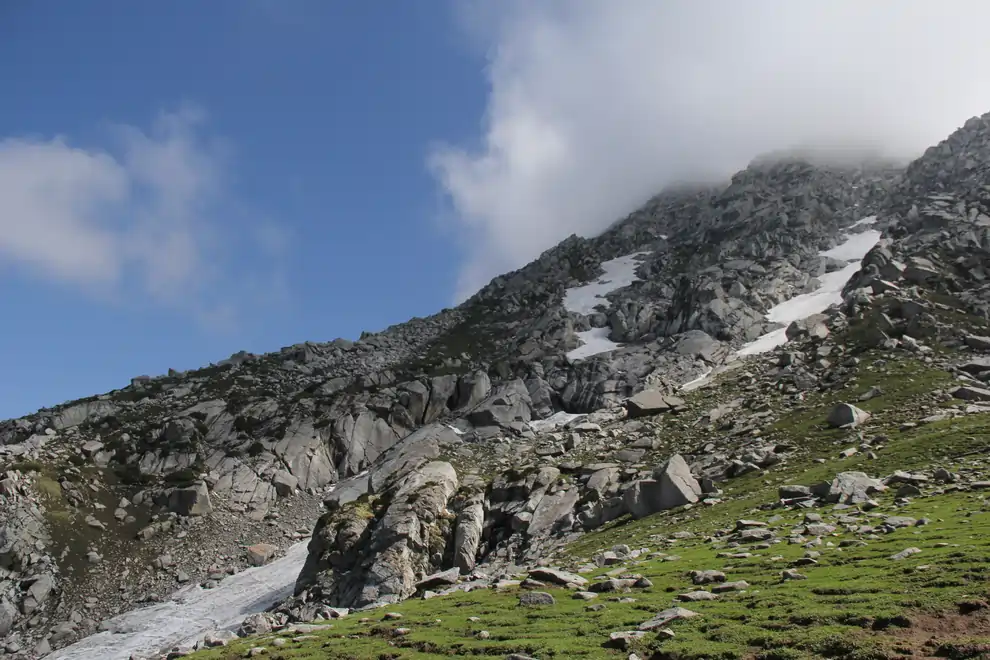
Difficult

Moon Peak Expedition
Moon Peak Expedition – Conquer the Heights of the Dhauladhar Range The Moon Peak Expedition is a thrilling…
SarPass Trek, Kasol runs 7 days in Himachal Pradesh, graded Easy, from Rs 5,499 per person.
It starts near Kasol in the Parvati Valley, climbs through pine and oak forest to the open meadows of Min Thach and Nagaru, and crosses a snow pass at roughly 4,200 m (about 13,800 ft). Pulga and Tulga: Twin villages with wooden houses and apple orchards, reached at the end of the long descent. Crossing Sar Pass: A pre-dawn climb up a snow slope to a pass at around 4,200 m, with a panorama of peaks and the Tosh valley on a clear morning. Camp life: Tents, sleeping bags, hot meals and evening conversation with a small group, which many people remember as much as the views. Day 6, Biskeri Thach to Barshaini: A long downhill through forest to Pulga, across the stream and the Parvati River bridge to Barshaini, where the trek ends and the return journey begins. Min Thach and Nagaru camps: Open campsites with wide views of the Parvati Valley, the Chanderkhani range and, on clear evenings, the lights of Manikaran far below. Day 4, Min Thach to Nagaru: Around 7 km and four to five hours through pastoral forest and open slopes to Nagaru, at about 3,800 m. Start point: Kasol, Parvati Valley (reached by overnight bus from Delhi in this package) Clothing: Three or four quick-dry layers, a fleece, a heavy down or padded jacket, a waterproof jacket and trousers, thermals, warm socks, a woollen cap, gloves and a spare set of clothes Day 3, Grahan to Min Thach: A breakfast, then about 7 km of climbing through forest to the meadow campsite at Min Thach, at roughly 3,400 m.
At 4,200 m the thin air is the real constraint on the SarPass Trek, Kasol, so the upper stretch is walked slowly and altitude symptoms are reported early.
The SarPass Trek, Kasol assembles at Delhi, and the day numbering runs from that point. Reporting times and the exact pickup point for the SarPass Trek, Kasol are confirmed on booking.
The SarPass Trek, Kasol is a realistic first outing, since its 7 days are short enough that fitness is not the barrier. Families with older children and anyone returning to walking after a break fit the SarPass Trek, Kasol comfortably. Solo travellers move inside a led group on the SarPass Trek, Kasol, so the pace is collective rather than personal.
Layers do more work than any single jacket on the SarPass Trek, Kasol, because the temperature at 4,200 m bears little relation to the trailhead. Footwear decides the day on the SarPass Trek, Kasol: loose stone and wet ground cause most slips, and a worn sole is the usual reason people struggle on the descent. Carry two litres of water each on the SarPass Trek, Kasol, a small first-aid kit, a head torch for pre-dawn walking, and food already tested on a training walk.
At 4,200 m on the SarPass Trek, Kasol, altitude illness is the main risk rather than the ground, so walk slowly and report a persistent headache or nausea immediately. A certified leader carries first aid and safety kit on the SarPass Trek, Kasol and reviews the forecast each morning, so the plan stays provisional until conditions are known. Travel insurance that covers trekking at this altitude is worth the small extra cost and is not part of the SarPass Trek, Kasol price.
The Rs 5,499 price of the SarPass Trek, Kasol covers accommodation on the itinerary, the listed meals, a certified leader with support crew, applicable permits and entry fees, and the safety equipment carried. Excluded from the SarPass Trek, Kasol are travel to the assembly point unless the itinerary says otherwise, personal kit and clothing, insurance, and anything the inclusions list does not name.
By road, on your own: Overnight buses run from Delhi and Chandigarh to Bhuntar and Kasol. Forest to meadow in a few days: The trail leaves the river valley, climbs through dense pine and oak and then opens onto grassy ridges known locally as thaches. Sliding down the snow: If conditions are safe and the trek leader agrees, the descent from the pass includes a controlled slide on the snow, a favourite moment for most groups. By rail: The nearest large rail stations are in Chandigarh and Pathankot, with buses on to Bhuntar. You start in the dark, climb to the pass, spend time at the top and then descend over snow and streams to Biskeri Thach, at around 3,350 m. On the far side, a long descent takes you down through Biskeri Thach and Pulga to the roadhead at Barshaini. End point: Barshaini, near Pulga, before the return journey to Delhi Biskeri Thach: A high campsite with streams and meadows after the pass day. Day 1, Delhi to Kasol: Leave Delhi by evening on the overnight bus and reach Kasol around 8 AM the next morning. Day 2, Kasol to Grahan Village: Meet the guides at around 9:30 AM for a short briefing, then walk about 7 km to Grahan village through pine forest. Day 5, Nagaru to Biskeri Thach via Sar Pass: The big day. Pass day is the real test: you wake around 4 AM, climb in cold air, cross the snow, descend a long way and still have to reach camp. It suits people who have done a few easy treks and want a proper step up: longer days, camps above the tree line, a pre-dawn start on pass day and a stretch of snow in most seasons. The Parvati Valley gets heavy monsoon rain, trails turn slippery, streams swell, landslides can block roads and clouds hide the views.
Browsing by region or activity is often faster than reading individual pages, so start with Himachal Pradesh and Trekking. The closest alternatives to the SarPass Trek, Kasol are Mcleodganj Triund Trek, Bhrigu Lake Trek and Beas Kund Trek, which suit anyone comparing dates or a slightly different grade.
The Sar Pass trek is one of the most popular early high-altitude treks in Himachal Pradesh. It starts near Kasol in the Parvati Valley, climbs through pine and oak forest to the open meadows of Min Thach and Nagaru, and crosses a snow pass at roughly 4,200 m (about 13,800 ft). On the far side, a long descent takes you down through Biskeri Thach and Pulga to the roadhead at Barshaini.
This WDRLUST package is a seven-day plan counted from Delhi to Delhi. Day 1 is the overnight journey to Kasol, days 2 to 6 are the trek, and day 7 is the return to Delhi. It suits people who have done a few easy treks and want a proper step up: longer days, camps above the tree line, a pre-dawn start on pass day and a stretch of snow in most seasons. SarPass is not technical, but it asks for steady fitness and a willingness to be cold and tired for a day or two.
Day 1, Delhi to Kasol: Leave Delhi by evening on the overnight bus and reach Kasol around 8 AM the next morning. The bus itself is run by an outside operator, so timings can vary.
Day 2, Kasol to Grahan Village: Meet the guides at around 9:30 AM for a short briefing, then walk about 7 km to Grahan village through pine forest. Expect three to four hours of walking, with a steeper, rockier section after the Grahan stream. Dinner and overnight stay at Grahan.
Day 3, Grahan to Min Thach: A breakfast, then about 7 km of climbing through forest to the meadow campsite at Min Thach, at roughly 3,400 m. You get your first views of Nagaru and the Sar Pass ridge from here.
Day 4, Min Thach to Nagaru: Around 7 km and four to five hours through pastoral forest and open slopes to Nagaru, at about 3,800 m. Evenings are very cold.
Day 5, Nagaru to Biskeri Thach via Sar Pass: The big day. You start in the dark, climb to the pass, spend time at the top and then descend over snow and streams to Biskeri Thach, at around 3,350 m.
Day 6, Biskeri Thach to Barshaini: A long downhill through forest to Pulga, across the stream and the Parvati River bridge to Barshaini, where the trek ends and the return journey begins.
Day 7, Delhi: You are due back in Delhi in the morning. The full day-wise plan is in the itinerary section of this page.
The most reliable months are mid-April to June and September to October. In spring and early summer the pass is usually snow-covered, which is why many people choose it: the snow slide is part of the appeal. Days are warm at the lower camps, nights at Nagaru are cold and the meadows begin to turn green by June. After the monsoon, from September to October, skies are clearer, the air is crisp and the pass may hold little snow, though early snowfall is possible in October.
Be careful with July and August. The Parvati Valley gets heavy monsoon rain, trails turn slippery, streams swell, landslides can block roads and clouds hide the views. Operators may reschedule or change the route in these months, and your guide’s judgement on the day should be followed without argument. From November to early April the upper trail is under deep snow and temperatures fall well below freezing, which makes the route a different and more demanding trek that needs extra gear and experience. Always ask the team about current snow and weather before you commit to a date.
Most trekkers rate Sar Pass as moderate, and for a first Himalayan trek it is on the harder side of that label. The first two days are steady climbs through forest. The third day is tougher, with a steeper climb above the tree line. Pass day is the real test: you wake around 4 AM, climb in cold air, cross the snow, descend a long way and still have to reach camp. Expect an eight-hour day or more.
The altitude is not extreme, but you will sleep above 3,000 m for three nights, and the pass at about 4,200 m is high enough for some people to get a headache or feel breathless. Your body adjusts best when you walk slowly and drink plenty of water.
Start training four to six weeks before you travel. Aim for 30 to 45 minutes of jogging, brisk walking or stair climbing, four or five times a week. Add squats and lunges for the legs and a weekend hike with a loaded backpack if you can. The goal is to walk six to eight hours on uneven ground without feeling wrecked. If you have a heart, lung or blood pressure condition, speak to a doctor before booking and tell the trek team in advance.
Plan to arrive in Kasol by the morning of day 2 so you have time for the briefing and the first walk. Keep a copy of a government photo ID with you, as it is usually needed for the forest permit.
Trekking poles are strongly recommended for the snow and the long downhill. They are not part of the included equipment list, so bring your own if you can.
You walk with a trek leader and guides, and the included equipment covers tents, sleeping bags and gaiters. Even so, the habits that keep you safe are simple: stay with the group, follow the guide’s pace on the snow, and never go off the marked line, especially near steep drops on the way to the pass.
Snow sections: The slope below the pass can be hard in the early morning and softer later in the day. Walk in the footsteps of the leader, use poles for balance and keep your hands out of your pockets. The snow slide is only done where the guide says it is safe. If you do not feel comfortable, walk down instead.
Weather and pass day: Mountain weather changes quickly. Clouds, wind or fresh snow can make the pass unsafe, in which case the leader may delay the crossing or turn the group around. Starting early matters, because the weather is generally best in the morning and the pass should be crossed before afternoon clouds build up.
Altitude: Walk slowly, drink three to four litres of water a day and tell your guide about any headache, nausea, dizziness or unusual tiredness. Do not push on if symptoms get worse. Descending is the main cure for altitude illness.
Leave no trace: The meadows are fragile. Carry every wrapper back, avoid single-use plastic, keep to the main trail, respect local villagers and keep noise down at camp.
This trek suits fit beginners who have done at least one easier trek, friends and small groups, and solo travellers who prefer joining a guided group. It is not ideal for anyone with heart or lung problems, severe knee trouble or a strong dislike of cold nights. If you want a shorter, gentler introduction to the Parvati Valley, the Grahan or Kasol Tosh itineraries linked below might be a better start.
The SarPass Trek, Kasol runs for 5 days. The day-by-day itinerary above lists each stage, walking distance and overnight stay.
The SarPass Trek, Kasol is rated Moderate by WDRLUST. It suits trekkers with some prior walking experience and steady fitness. Training with 45 to 60 minutes of cardio three times a week for six weeks before departure is enough for most people.
The SarPass Trek, Kasol starts at Rs 5,499 per person. The price covers the inclusions listed on this page. Transport to the starting point, personal gear and anything not listed under inclusions are extra.
The route reaches approximately 4,200 m. Walk slowly, drink water and report any headache or nausea to your trek leader.
Group size is capped at Max 12 trekkers per departure, with a certified trek leader. Smaller groups mean faster head counts and more attention on the trail.
The SarPass Trek, Kasol starts from the base location described in the itinerary above. WDRLUST shares exact meeting points, reporting times and transport options on booking confirmation. The nearest major access region is Kasol.
Explore related pages: All treks in Kasol · Treks in Himachal Pradesh · Trekking in India · Browse all destinations · All activities.
Leave Delhi in the evening (after 5 PM) and reach Kasol around 8 AM the next morning. The bus is run by an outside operator, so WDRLUST is not responsible for its running or punctuality, and timings can vary.
Meet the guides at around 9:30 AM for a short briefing and begin the walk to Grahan, about 7 km through pine forest. The path gets steeper and rockier after the Grahan stream, and you reach the village after about an hour more. Dinner and overnight stay at Grahan.
After breakfast, start around 8:30 AM and climb about 7 km through lush forest to the meadow campsite at Min Thach. Along the way you see Nagaru and the Sar Pass ridge, and from camp there are wide views of the Chanderkhani range.
After breakfast, walk about 7 km through pastoral forest and open slopes to Nagaru. Expect four to five hours of steady climbing. In the evening you can see the lights of Manikaran far below, and it gets very cold.
Wake at around 4 AM and start in the dark. Climb the snow trail with views of the Tosh valley peaks, then spend some time at the top of the pass. If the guide says conditions are safe, slide down the snow with the right precautions. After about an hour of walking and several stream crossings, reach the Biskeri Thach campsite by evening.
Start around 9:30 AM and walk about 7 km downhill through dense forest, crossing a stream to reach Pulga. The twin villages of Pulga and Tulga are separated by a stream. Cross the bridge over the Parvati River to reach Barshaini, where the trek ends and the return journey begins.
Reach Delhi in the morning.


Moon Peak Expedition – Conquer the Heights of the Dhauladhar Range The Moon Peak Expedition is a thrilling…
The Indrahar Pass grants you to unwind within the great thing about the mighty Dhauladhar range of Himalayas.…
Kodachadri Trek Kodachadri, located in the Western Ghats of Karnataka, is a popular destination for trekking enthusiasts due…