Difficult
Kalindi Khal Trek
One of the most demanding classical treks in the Indian Himalaya — a glacier-crossing expedition linking the sacred…
Deoriatal Chandrashila Trek runs 4 days in Uttarakhand, graded Easy, from Rs 6,800 per person.
From Deoriatal, the trail continues through increasingly open meadow and forest towards Rohini Bugyal and eventually Syalmi Village or Baniyakund, gaining altitude steadily but without any single demanding stretch, before reaching the base camp for the Chandrashila summit push. The summit push to Chandrashila itself, undertaken in the pre-dawn hours from base camp, culminates at 3,680 metres in a panorama that rivals treks considerably longer and harder: Nanda Devi, Trishul, Kedarnath, Bandarpoonch, and Chaukhamba visible together as first light moves across the range. Deoriatal Chandrashila combines two of Garhwal’s most celebrated short-trek destinations into a single, well-balanced four-day itinerary — a still, forest-ringed lake famous for its reflection of the Chaukhamba massif, followed by a genuine Himalayan summit with one of the widest panoramas available anywhere in Uttarakhand at this trek grade. With its comfortable overall gradient, mythological depth, and a summit view that punches well above the trek’s easy-to-moderate grading, Deoriatal Chandrashila has become a dependable recommendation for trekkers — families, first-timers, and seasoned trekkers short on time alike — looking for maximum Himalayan payoff from a short and manageable itinerary. This single view has made the lake one of the most photographed short-trek destinations in Uttarakhand, and most itineraries build in an overnight camp beside the lake specifically to catch this effect at dawn, before day-trippers arrive later in the morning. On calm mornings, before any wind disturbs the surface, Deoriatal produces one of the clearest mirror reflections of a major Himalayan peak found anywhere in the region — Chaukhamba’s serrated summit doubling itself perfectly in the still water.
The trek starts from Sari village, with a 2.5 km climb to Deoriatal that takes about an hour and a half. Deoriatal is a small lake whose main draw is the reflection of snow peaks such as Chaukhamba at sunrise. From Deoriatal the route goes through forest and meadow to Chopta, which is the base for the Tungnath climb. Tungnath is the highest Shiva temple in the world, at about 3,680 m (12,073 ft). The walk from Chopta to Tungnath is a little over 4 km, and a further steep 1.5 km reaches Chandrashila summit. Chandrashila stands at about 3,962 m (13,000 ft) and gives a 360-degree view including Nanda Devi, Trishul and Kedarnath. The Deoriatal to Chopta link through Rohini Bugyal takes around six hours and is less clearly marked. Dhabas sit at intervals on the Tungnath climb, and camps are available near Deoriatal.
Around 2,438 m the air on the Deoriatal Chandrashila Trek is thin enough to notice but not high enough to need acclimatisation days.
The Deoriatal Chandrashila Trek is a realistic first outing, since its 4 days are short enough that fitness is not the barrier. Families with older children and anyone returning to walking after a break fit the Deoriatal Chandrashila Trek comfortably. Solo travellers move inside a led group on the Deoriatal Chandrashila Trek, so the pace is collective rather than personal.
Mornings on the Deoriatal Chandrashila Trek are cold and afternoons warm quickly at 2,438 m, so a light fleece plus a shell covers almost everything. Footwear decides the day on the Deoriatal Chandrashila Trek: loose stone and wet ground cause most slips, and a worn sole is the usual reason people struggle on the descent. Carry two litres of water each on the Deoriatal Chandrashila Trek, a small first-aid kit, a head torch for pre-dawn walking, and food already tested on a training walk.
The main risks on the Deoriatal Chandrashila Trek at this height are slips on wet sections and dehydration on exposed stretches, both prevented by steady pacing. A certified leader carries first aid and safety kit on the Deoriatal Chandrashila Trek and reviews the forecast each morning, so the plan stays provisional until conditions are known. Travel insurance that covers trekking at this altitude is worth the small extra cost and is not part of the Deoriatal Chandrashila Trek price.
The Rs 6,800 price of the Deoriatal Chandrashila Trek covers accommodation on the itinerary, the listed meals, a certified leader with support crew, applicable permits and entry fees, and the safety equipment carried. Excluded from the Deoriatal Chandrashila Trek are travel to the assembly point unless the itinerary says otherwise, personal kit and clothing, insurance, and anything the inclusions list does not name.
Because this same summit is reachable from the Chopta side as well, the two routes are sometimes combined or treated as alternatives, but the Deoriatal approach adds the lake’s reflection as a genuine bonus rather than simply an alternate access point. This section of the trek moves through a genuinely varied landscape — dense forest giving way to open bugyal (alpine meadow) grazing land still used seasonally by local shepherds, with increasingly wide views opening up as the trail climbs. Together, they make an efficient introduction to Garhwal Himalayan trekking for people with limited time but genuine ambition to see high mountains up close.
Browsing by region or activity is often faster than reading individual pages, so start with Uttarakhand. The closest alternatives to the Deoriatal Chandrashila Trek are Har Ki Dun Valley Trek, Brahmatal Trek and Rupin Pass Trek, which suit anyone comparing dates or a slightly different grade.
Deoriatal Chandrashila combines two of Garhwal’s most celebrated short-trek destinations into a single, well-balanced four-day itinerary — a still, forest-ringed lake famous for its reflection of the Chaukhamba massif, followed by a genuine Himalayan summit with one of the widest panoramas available anywhere in Uttarakhand at this trek grade. Together, they make an efficient introduction to Garhwal Himalayan trekking for people with limited time but genuine ambition to see high mountains up close.
The trek begins at Sari village, a short drive from Ukhimath, and climbs through rhododendron and oak forest for roughly two hours before reaching Deoriatal itself, a small lake at 2,438 metres held in local legend to be the site where the Pandava brothers were tested with riddles by a Yaksha before being permitted to drink from its waters — a story that ties this lake, like so many in the region, back into the broader Mahabharata mythology that threads through much of Garhwal’s sacred geography.
On calm mornings, before any wind disturbs the surface, Deoriatal produces one of the clearest mirror reflections of a major Himalayan peak found anywhere in the region — Chaukhamba’s serrated summit doubling itself perfectly in the still water. This single view has made the lake one of the most photographed short-trek destinations in Uttarakhand, and most itineraries build in an overnight camp beside the lake specifically to catch this effect at dawn, before day-trippers arrive later in the morning.
From Deoriatal, the trail continues through increasingly open meadow and forest towards Rohini Bugyal and eventually Syalmi Village or Baniyakund, gaining altitude steadily but without any single demanding stretch, before reaching the base camp for the Chandrashila summit push. This section of the trek moves through a genuinely varied landscape — dense forest giving way to open bugyal (alpine meadow) grazing land still used seasonally by local shepherds, with increasingly wide views opening up as the trail climbs.
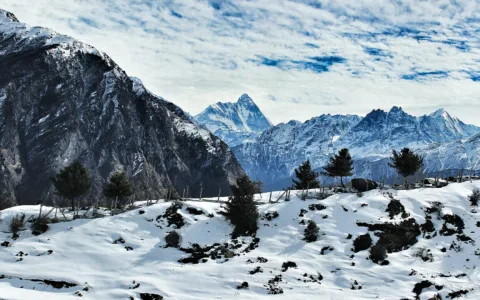
The summit push to Chandrashila itself, undertaken in the pre-dawn hours from base camp, culminates at 3,680 metres in a panorama that rivals treks considerably longer and harder: Nanda Devi, Trishul, Kedarnath, Bandarpoonch, and Chaukhamba visible together as first light moves across the range. Because this same summit is reachable from the Chopta side as well, the two routes are sometimes combined or treated as alternatives, but the Deoriatal approach adds the lake’s reflection as a genuine bonus rather than simply an alternate access point.
With its comfortable overall gradient, mythological depth, and a summit view that punches well above the trek’s easy-to-moderate grading, Deoriatal Chandrashila has become a dependable recommendation for trekkers — families, first-timers, and seasoned trekkers short on time alike — looking for maximum Himalayan payoff from a short and manageable itinerary.
The Deoriatal Chandrashila Trek runs for 4 days. The day-by-day itinerary above lists each stage, walking distance and overnight stay.
The Deoriatal Chandrashila Trek is rated Easy by WDRLUST. It suits first-time trekkers with reasonable fitness. Training with 45 to 60 minutes of cardio three times a week for six weeks before departure is enough for most people.
The Deoriatal Chandrashila Trek starts at Rs 6,800 per person. The price covers the inclusions listed on this page. Transport to the starting point, personal gear and anything not listed under inclusions are extra.
The route reaches approximately 2,438 m. Walk slowly, drink water and report any headache or nausea to your trek leader.
Group size is capped at Max 18 trekkers per departure, with a certified trek leader. Smaller groups mean faster head counts and more attention on the trail.
The Deoriatal Chandrashila Trek starts from the base location described in the itinerary above. WDRLUST shares exact meeting points, reporting times and transport options on booking confirmation. The nearest major access region is Uttarakhand.
The Deoriatal and Chandrashila combination strings together two of the best short objectives in Uttarakhand: a lake that reflects Chaukhamba on a still morning, and the 4,000 m ridge above Tungnath. The four-day format is built around getting both.
The trek fee is Rs 6,800 per person:
Plan on Rs 17,000 to Rs 24,000 all-in. The Deoriatal section adds a night and a different landscape for a modest increase over the Tungnath-only option.
Rated Easy. Individually, Deoriatal is a gentle 3 km climb through forest and Chandrashila is a steady stone path. Together they make a comfortable four days with total walking around 18 to 20 km.
The point to note is that the two objectives have different best times of day. The lake reflection needs a still dawn, and the ridge view needs clear air, so the itinerary is sequenced around early starts. If you are not a morning person, this trek will test that more than the gradient will.
Deoriatal sits in dense forest, and in the monsoon the trail is muddy and the leeches are active on the forest floor. The lake turns grey and choppy, which removes the reflection entirely. Above Tungnath the ridge is exposed and a storm means retreat.
The road in through Rudraprayag and Ukhimath is one of the more slide-prone stretches in Uttarakhand during July and August. If your return flight from Delhi is fixed, leave a day of slack.
Fly to Delhi on a Thursday or Friday night, join the overnight drive to Sari village, trek the four days, and return to Delhi for a flight home. That is five nights away. Deoriatal’s first camp is at Sari, which is reachable by road, so day one is mostly travel and a short walk.
Explore related pages: All treks in Uttarakhand · Browse all destinations · All activities.
Drive to Sari village, trek through forest to Deoriatal lake (2,438m). Overnight camping beside the lake.
Trek through meadow and forest towards the Chandrashila base camp.
Pre-dawn summit push to Chandrashila (3,680m) for panoramic sunrise views, descend to base camp or onward towards Sari.
Final descent to Sari village and drive back for onward journey.
One of the most demanding classical treks in the Indian Himalaya — a glacier-crossing expedition linking the sacred…
Uttarakhand road trip, 5N/6D from Delhi, graded Easy, from Rs 11,500. Rishikesh, Chopta and Tungnath, Auli and Nainital…
A remote Kumaon expedition to the base of five sacred peaks said to mark the Pandavas' final cooking…