
Easy
Dayara Bugyal Trek
A short winter classic to one of Uttarakhand's largest and most pristine high-altitude meadows, framed by Bandarpoonch and…
Next Departure
12/10/2026
14 seats left
Har Ki Dun translates loosely as “valley of the gods”, and the name is not marketing — it comes directly from local legend. Villagers here believe this cradle-shaped valley, hemmed in by the jagged Swargarohini massif, is the very path the Pandava brothers took on their final ascent to heaven at the end of the Mahabharata. Whether or not you arrive believing the myth, the valley’s atmosphere makes it easy to understand why it took hold: a wide, flat-bottomed bowl of grazing meadows framed by five glaciated summits, reached through some of the oldest continuously inhabited villages in the Garhwal Himalaya.
The trek begins at Sankri, a small hub village that has become the base camp for several Garhwal treks, and the trail almost immediately passes through Taluka and Osla — villages built from intricately carved wood and slate, where the architecture and even the local deities differ from anything found lower in the valley. Osla in particular is known for its wood-carved temple to Duryodhana, the Mahabharata’s antagonist, worshipped here as a local deity in a rare inversion found nowhere else in India. Trekkers often pause to appreciate homes that have stood for generations, their timber facades carved with geometric patterns unique to this pocket of the Himalaya.
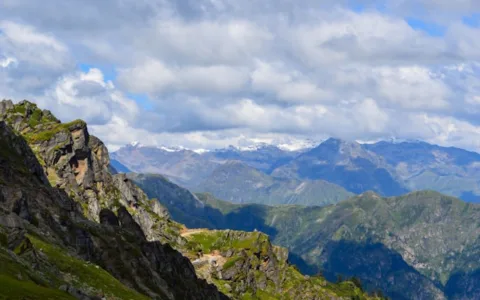
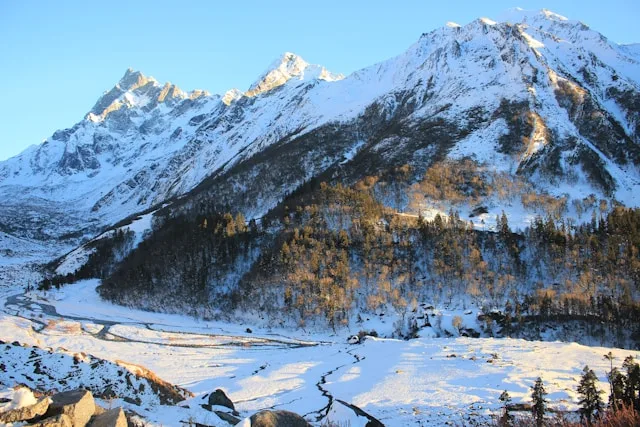
Beyond Osla, the trail climbs gently along the Supin river through forests of deodar, oak, and maple that turn brilliant shades of copper and gold in October. The valley opens out gradually rather than dramatically, so the sense of arrival builds slowly — by the time you reach the Har Ki Dun meadow itself, at roughly 3,600 metres, the full amphitheatre of peaks is already visible: Swargarohini I, II and III, along with Bandarpoonch and bench-like ridgelines that give the valley its distinctive bowl shape.
What sets Har Ki Dun apart from more strenuous Himalayan treks is its gradient. The ascent is spread comfortably over several days with no single brutal climbing day, making it an excellent introduction to multi-day Himalayan trekking for people with reasonable fitness but limited high-altitude experience. That gentleness, combined with the cultural depth of the villages along the route, is precisely why guides and repeat trekkers rate it among the most well-rounded treks in the Garhwal region — as much a walk through living history as a mountain trail.
Wildlife sightings are a genuine possibility here too: the region falls within the Govind Wildlife Sanctuary, and blue sheep, Himalayan monal, and occasionally snow leopard tracks are reported by local shepherds during the summer grazing season. Base camp at Har Ki Dun itself sits beside a small forest rest house, and most groups spend a full day here simply absorbing the valley before the return trek — a rare Himalayan itinerary generous enough with time to actually stop climbing and look around.
The best seasons are April to June and September to November; monsoon months bring landslides on the approach road to Sankri and are best avoided. Nights below zero are common even in autumn, so a good sleeping bag matters more than raw fitness on this particular trail.
Arrive at Sankri village (1,920m). Briefing, gear check, and overnight stay.
Drive to Taluka, trek through forest to the ancient wooden village of Osla (2,559m).
Climb gently along the Supin river to the Har Ki Dun meadow (3,566m), with views of the Swargarohini range.
Full day exploring the valley, including the viewpoint towards Jaundhar Glacier. Return to base camp.
Descend back through the meadows to Osla village.
Trek back to Taluka and drive to Sankri.
Drive from Sankri to Dehradun for onward journey.
A short winter classic to one of Uttarakhand's largest and most pristine high-altitude meadows, framed by Bandarpoonch and…
A dramatic high-altitude crossing linking Uttarakhand and Himachal, famous for its hanging villages, a near-vertical snow wall, and…
A pilgrimage-turned-trek to the source of the Ganga at the snout of the Gangotri Glacier, ending on a…