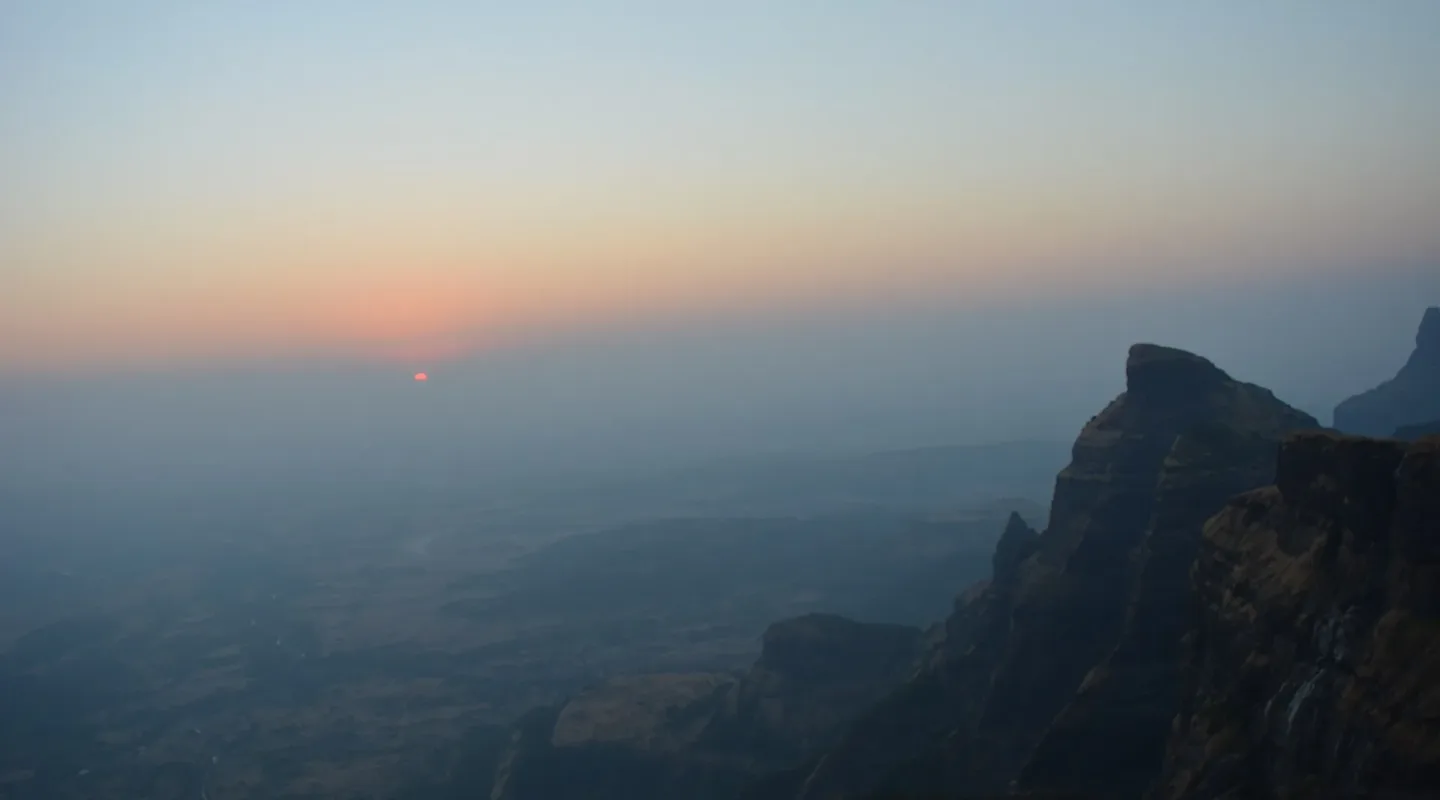

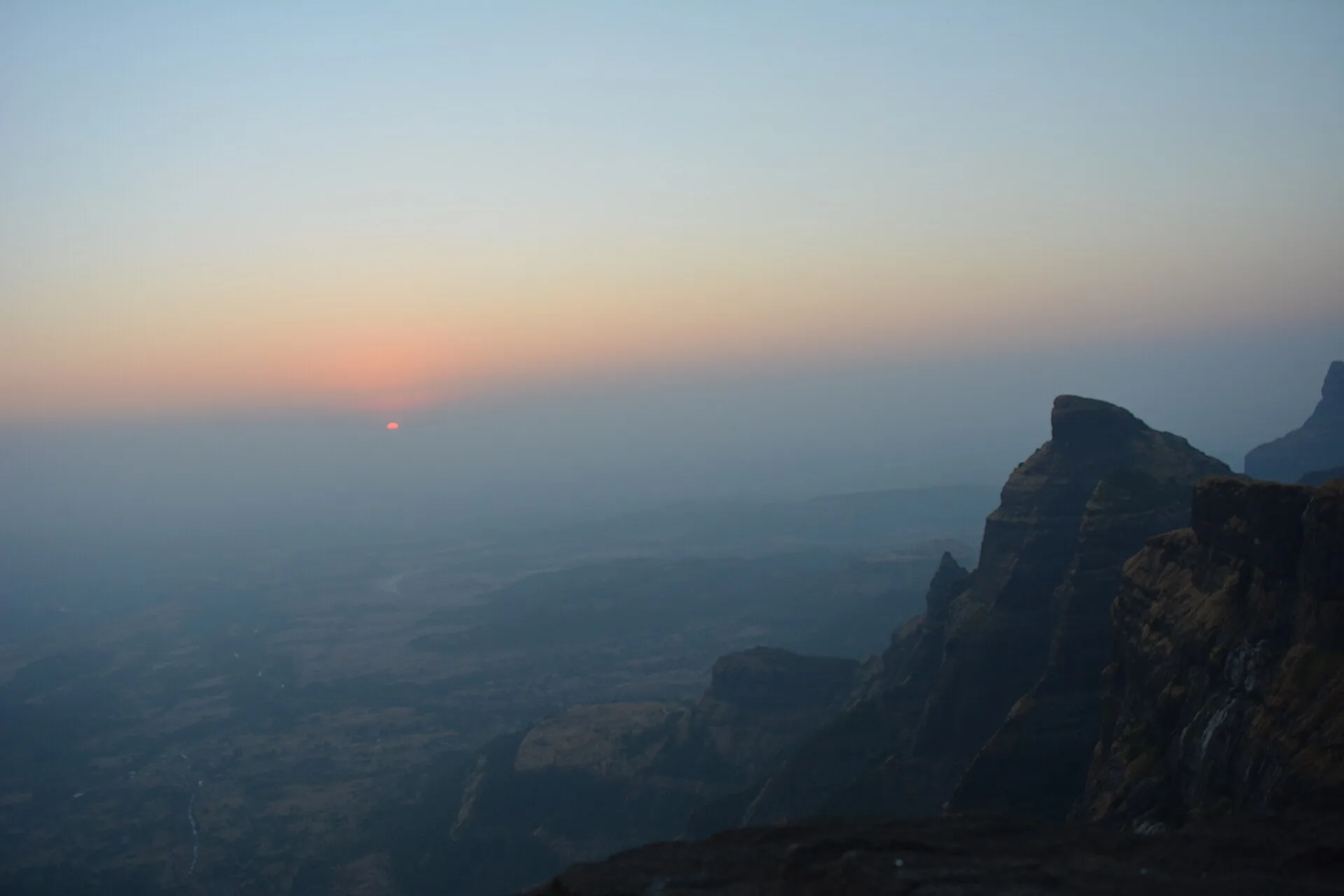
November is the month Maharashtra’s trekking calendar quietly resets. The monsoon has gone, the Sahyadri hills are still green rather than the burnt brown of February, and the nights are cold enough at the top to make a sunrise worth the climb. If you have been waiting for the right window to do one of these Sahyadri night treks, this is it — but the three big ones are not interchangeable, and picking the wrong one for your group is the most common way a weekend goes wrong.
This guide covers the three Sahyadri treks we run out of Mumbai and Pune right now: Kalsubai, Harishchandragad and the AMK trio. Real altitudes, real prices, real departure dates, and an honest account of what each one asks of you.
Why November works for a Sahyadri night trek
Three things line up in the second half of November. The post-monsoon greenery is still there — the hills have not yet dried to straw, and the seasonal streams in the ghats are still running. Night temperatures at 1,400–1,650 m drop to roughly 10–14°C, cold enough for a jacket at the summit before dawn but nowhere near the hypothermia risk of a Himalayan winter trek. And the air is at its clearest: the haze that builds through December and January has not settled yet, so the sunrise views across the range are at their sharpest.
What is not good about November: the same clear skies mean the nights are genuinely cold on the exposed summits, and the post-monsoon grass hides loose rock on the descents. More importantly, this is peak season for weekend treks out of both cities, so the popular routes are busy on Saturday nights. If you want a quiet summit, go midweek or pick the less-travelled of the three below.
The three Sahyadri night treks, compared
| Trek | Altitude | Duration | Grade | Price | Best for |
|---|---|---|---|---|---|
| Kalsubai Peak | 1,646 m | 2 days | Easy | ₹1,800 | First night trek, sunrise |
| Harishchandragad | 1,424 m | 2 days | Moderate | ₹4,200 | Fort, cliffs, photography |
| AMK (Alang–Madan–Kulang) | 1,478 m | 2 days | Moderate | ₹3,000 | Scrambling, three forts |
Kalsubai Peak: the highest point in Maharashtra
At 1,646 m, Kalsubai is the highest point in Maharashtra, and the climb from Bari village gains roughly 800 m over about 6 km. It is graded Easy on our Kalsubai Peak Trek page, and that grade is fair — but “easy” here means short and non-technical, not effortless. The last stretch to the summit goes up iron ladders bolted to the rock face, and in the dark, with a queue of trekkers behind you, that is the part people remember.
The reward is the reason this trek is booked out most weekends: from the top you look across the Bhandardara reservoir and, on a clear morning, pick out Alang, Madan and Kulang on the skyline — the three forts in the next section. The temple at the summit is a useful windbreak while you wait for light.
Honest caveat: the ladders are the bottleneck. On a busy Saturday night you can spend 20–30 minutes waiting at the base of them. If you are uncomfortable with exposure on fixed ladders, this is not the trek to start with — Harishchandragad’s Khireshwar route has no equivalent section.
Harishchandragad: the fort with the cliff
Harishchandragad sits at 1,424 m in the Malshej Ghat region, about 160 km from Pune and 210 km from Mumbai. The Harishchandragad Trek runs 2 days and 1 night, graded Moderate, from ₹4,200 per person, climbing from Khireshwar through Tolar Khind to the fort plateau.
What makes it worth the extra money over Kalsubai is the plateau itself. There is a temple, a cave holding a Shiva lingam standing in water, a rock-cut water tank, and then Konkan Kada — a cliff that falls away in one continuous concave sweep, roughly 600 m of air below the edge. At sunrise the cloud sitting in the Konkan plain below the cliff edge is the shot everyone comes for.
Honest caveat: the Tolar Khind section involves a short rock patch with a fixed rope, and the descent is harder on the knees than the climb. It is also the busiest of the three on weekends — the plateau can hold a lot of people, and it does.
AMK: three forts, one weekend
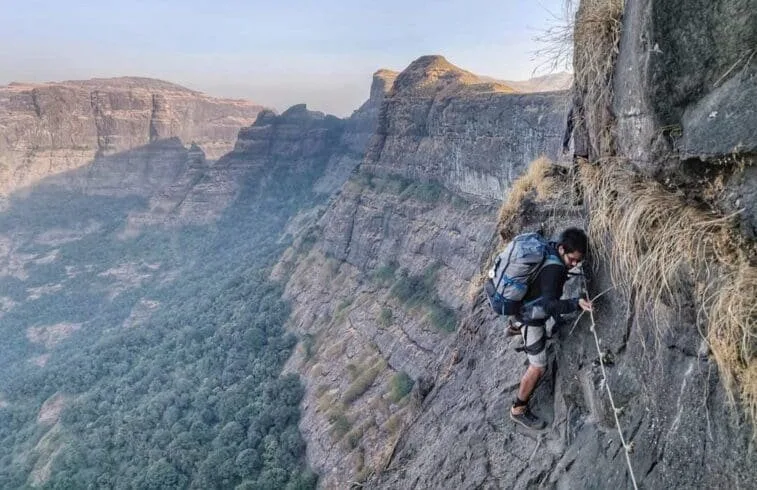
The AMK – Alang Madan Kulang Trek is the connoisseur’s option: 2 days, graded Moderate, from ₹3,000 per person, and the only one of the three that puts three separate summits under you. Alang stands at roughly 1,478 m, Madan at about 1,475 m, and Kulang close behind.
This is the one with actual scrambling. There are sections where you are on hands and rock, and the route between forts is longer and rougher than either of the other two. It is also the least crowded, because the effort filters people out.
Honest caveat: if you have never scrambled before, do Kalsubai or Harishchandragad first. AMK is graded Moderate but it is the top end of Moderate, and the exposure on the Alang approach is real.
Which one should you book?
If it is your first night trek and you want the classic sunrise, take Kalsubai — it is the cheapest at ₹1,800 and the shortest commitment. If you want the best photographs and a fort to explore, take Harishchandragad; Konkan Kada at dawn is the single best view in the range. If you have done a few treks and want something with teeth, take AMK.
Whichever you pick, read our guide to choosing the right trek difficulty before you book, and pack for a cold summit rather than a warm valley — the temperature difference between Bari village and the Kalsubai top after dark is easily 8–10°C.
The mistake almost every first-timer makes on a Sahyadri night trek is dressing for the trailhead. You start at 20°C in a t-shirt and spend two hours at the summit in 11°C wind waiting for the sun. Carry the jacket you think you will not need.
Frequently asked questions
Is November a good month for a Sahyadri night trek?
Yes — it is arguably the best. The hills are still green from the monsoon, night temperatures at 1,400–1,650 m sit around 10–14°C, and the air is clearer than in December or January. The trade-off is that weekends are busy.
Do I need prior trekking experience for Kalsubai?
No. Kalsubai is graded Easy and is a reasonable first trek, though the iron ladders near the summit require a head for heights. If ladders worry you, Harishchandragad’s Khireshwar route is a better first choice.
How cold does it get at the summit at night?
Expect roughly 10–14°C on the summit before dawn in November, with wind making it feel colder. A fleece or light down jacket, a cap and gloves are enough — this is not a Himalayan winter trek.
Which of the three is the least crowded?
AMK. The scrambling and the longer route between forts keep numbers down. Harishchandragad is the busiest on weekends because the plateau is accessible and the views are famous.
Can I do these as a day trek instead of overnight?
Kalsubai and Harishchandragad are both run as 2-day trips with a night start so you reach the summit for sunrise. The night start is the point — it is what gets you the view.
What to book next
If you want to keep going after November, the November long weekend treks under ₹6,000 cover the short-format options across the country, and if you are thinking about a bigger winter objective, our guide to Ladakh winter treks covers what the cold season actually asks of you.
For the full packing list, see 10 essential packing tips for high-altitude treks.
Weather and trail conditions change. Check the India Meteorological Department forecast for your district in the 48 hours before departure.
